

 |
That everyone who thirsteth for the
truth may obtain it, this tract is mailed free of charge. It levies
one exaction, the soul's obligation to itself to prove all things fast
and hold fast that which is good. The only strings attached to this
free proffer are the golden strands of Eden and the crimson cords of Calvary
-- the ties that bind.
Tract 5
2
Rev. 8:6-13. "And the seven angels which had the seven trumpets prepared themselves to sound. The first angel sounded, and there followed hail and fire mingled with blood, and they were cast upon the earth: and the third part of trees was burnt up, and all green grass was burnt up.
"And the second angel sounded, and as it were a great mountain burning with fire was cast into the sea: and the third part of the sea became blood; and the third part of the creatures which were in the sea, and had life, died; and the third part of the ships were destroyed.
"And the third angel sounded, and there fell a great star from heaven, burning as it were a lamp, and it fell upon the third part of the rivers, and upon the fountains of waters; and the name of the star is called Wormwood: and the third part of the waters became wormwood; and many men died of the waters, because they were made bitter.
"And the fourth angel sounded, and the third Part of the sun was smitten, and the third part of the moon, and the third part of the stars; so as the third part of them was darkened, and the day shone not for a third part of it, and the night likewise.
"And I beheld, and heard an angel flying through the midst of heaven, saying with a loud voice, Woe, woe, woe, to the inhabiters of the earth by reason of the other voices of the trumpet of the three angels, which are yet to sound!"
Tract 5 3
Rev. 9:1-4. "And the fifth angel sounded, and I saw a star fall from heaven unto the earth: and to Him was given the key of the bottomless pit. And he opened the bottomless pit; and there arose a smoke out of the pit, as the smoke of a great furnace; and the sun and the air were darkened by reason of the smoke of the pit. And there came out of the smoke locusts upon the earth: and unto them was given power, as the scorpions of the earth have power. And it was commanded them that they should not hurt the grass of the earth, neither any green thing, neither any tree; but only those men which have not the seal of God in their foreheads."
Rev. 9:13-19. "And the sixth angel sounded, and I heard a voice from the four horns of the golden altar which is before God, saying to the sixth angel which had the trumpet, Loose the four angels which are bound in the great river Euphrates. And the four angels were loosed, which were prepared for an hour, and a day, and a month, and a year, for to slay the third part of men. And the number of the army of the horsemen were two hundred thousand thousand: and I heard the number of them. And thus I saw the horses in the vision, and them that sat on them, having breastplates of fire, and of jacinth, and brimstone: and the heads of the horses were as the heads of lions; and out of their mouths issued fire and smoke and brimstone. By these three was the third part of men killed, by the fire, and by the smoke, and by the brimstone, which issued out of their mouths. For their power is in their mouth, and in their tails: for their tails were like unto serpents, and had heads, and with them they do hurt."
Ever since John recorded this imposing symbolization, church history has repeatedly throughout her pages had to
Tract 5 4
make the entry that every attempt made to unlock its mystery has but resulted the more in barricading it with mysticism and confusion. It is necessary, therefore, in clearing the mysticism, first of all to find
THE REASON FOR THE CONFUSION.
The very fact that nineteen centuries of prying at the subject to open it up has only made it the more impenetrable, is the strongest possible evidence that God controls the Scriptures and reveals Them only at the divinely appointed time. The truth of this statement is conclusively substantiated by the angel's words: "I will shew thee that which is noted in the scripture of truth: and there is none that holdeth with me in these things, but Michael your Prince." Dan. 10:21.
And "when He, the Spirit of Truth, is come," says Christ, in broader statement of this same truth, "He will guide you into all truth." John 16:13.
Having been put forth prematurely and without the prompting of the Spirit of Truth, human efforts have accordingly failed to discover and explain the truth of "the trumpets." And no scripture ever being unfolded without Inspiration, the expositions of uninspired minds are hence of private interpretation, in forewarning of which the Bible says: "....no prophecy of the scripture is of any private interpretation." 2 Pet. 1:20.
Tract 5 5
So before a person can climb the ladder of Truth, he must first of all free himself from erroneous theories, which keep him bound in darkness. And to loose himself from such weights of error so as to reach the top step of the ladder of Truth, he must carefully investigate and "prove all things" in
Open-Mindedness.
"Do not read the Word in the light of former opinions; but, with a mind free from prejudice, search it carefully and prayerfully. If, as you read conviction comes, and you see that your cherished opinions are not in harmony with the Word, do not try to make the Word fit these opinions. Make your opinions fit the Word. Do not allow what you have believed or practiced in the past to control your understanding." -- Messages to Young People, p. 260.
This prime necessity urgently confronts those who have been disposed to accept, as unquestionable Bible truths, theories which are the results of
Adding To and Taking From the Scriptures.
Any explanation of a prophecy which adds to or takes from any part of relevant scripture in order to harmonize the interpretation, can only be false. When the Spirit of God interprets the Scriptures, He does not in any way need to alter any part of Them in order to make the explanation
Tract 5 6
fit that which is being unfolded. When, moreover, the true interpretation of a prophecy is made, it always contains a lesson of present truth "adapted to the necessities of God's people" (The Great Controversy, p. 609) at the time the scripture is revealed. Knowing this, Satan is continually
Paving the Way for Sinning Against the Holy Ghost.
No one is lost for believing a false interpretation of a prophecy before the truth of it is revealed, provided the false interpretation does not draw him away from some other truth. Such individuals, however, are in great danger because, as history reveals, very few who become thus involved in error are willing to humble themselves by renouncing their errors and accepting the truth when it is made known. They are consequently in constant peril of sinning against the Holy Ghost. And being acutely aware of this, Satan misinterprets the prophecies before they are divinely revealed. He realizes full well that many, unwilling to be corrected and to exchange their errors for revealed truth, will thereby be led to eternal ruin. All-important, therefore, is the need that the student of the truth fortify himself with all honesty and humility as the light of truth is now turned searchingly on
Popular Theories.
To begin with, the reader's attention is called to Elder Uriah Smith's book, originally
Tract 5 7
entitled Thoughts on Daniel and The Revelation, and later Daniel and The Revelation, in which is explained, among other subjects, the subject of "the seven trumpets." Here one will notice that Elder Smith is not the original author of the exposition of the trumpets. The originators were Messrs. Keith, Clark, Barnes, et al. "Thus far," says Elder Smith, "Keith has furnished us with illustrations of the sounding of the first five trumpets." -- Daniel and The Revelation, p. 506.
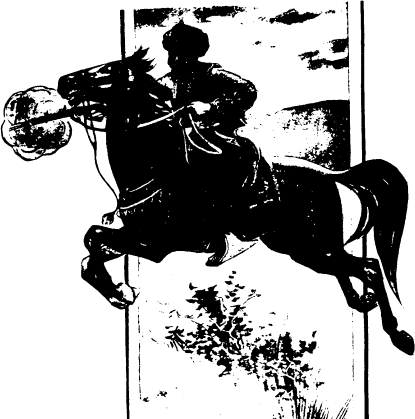
Then further in the same chapter, and in explanation of Revelation 9:17, we read: "As the Turks discharged their firearms on horseback, it would appear to the distant beholder, that the fire, smoke and brimstone issued out of the horses' mouths, as illustrated by the accompanying plate." -- Id., p.510. "Barnes thinks this was the case," remarks Elder Smith; "and a statement from Gibbon confirms this view." -- ld., p. 510, footnote.
Thus, plainly, the interpretation of the seven trumpets, as it is found in Thoughts on Daniel and the Revelation, was not originated by the Seventh-day Adventist denomination. But their placing upon it their endorsement makes it appear as Seventh-day Adventist doctrine. In other words, the theories of uninspired men having the S.D.A. stamp of approval, are made to appear to the S.D.A. laity as genuine S.D.A. Bible doctrines. This goes to show that the majority of Seventh-day
Tract 5 8
Adventists, right along with others, do not ask, "Is it true, -- in harmony with God's word? but, By whom is it advocated?" -- Testimonies to Ministers, p.106. And if the theory comes through a popular channel, they as a rule unquestionably accept it!
A fair example is their unhesitatingly applauding such manipulations as rationalizing "the heads of lions" (in the symbolism of Revelation 9:17) into heads of Arabian horses, and the serpent-like tails (Rev. 9:19), into common horses' tails (as evidenced by the accompanying illustration) in order to connect the trumpets with the battles of the Turks!
But even worse, they unhesitatingly agree that the "fire," "smoke,'' and "brimstone" did not issue, as John saw them, from the lion-like mouths, but rather from a gun in the hand of a Turk!
Their accepting these additions and subtractions to and from Holy Writ, a practice condemned by the Scriptures (Rev. 22:18, 19), shows that they are victims of a faulty vision, which causes them to think themselves right when they are all wrong (Testimonies, Vol. 3, pp. 252, 253).
Their subscribing to such a practice, moreover, undermines faith in the Bible, for if the Revelator be wrong in one instance, then can he not be mistaken in other instances also? And if we cannot depend upon the book of The Revelation
Tract 5 9
just as it reads, then how can we put confidence in any of the Bible? And if inspired prophets cannot declare the positive truth of what they see, then how can uninspired students of their writings declare
Tract 5 10
it? So, those who learn "to give an answer to every man that asketh...a reason of the hope that is in" (1 Pet. 3:15) them, will have no trouble answering the question:
Did John See Correctly?
True, the seer of Patmos was an erring human being like ourselves, but the one who dictated His writings -- the great and infallible I Am, Overseer and Proof Reader of the Scriptures -- was there to see that John made a faithful record of what he saw, for the exact truth of the symbolism means our very life. Indeed, it is not possible that the Lord would jeopardize our salvation by displaying the symbolism so far removed from John's sight that he could not accurately see and record it, and yet expect to save us by it.
If John failed to see correctly the symbols in the vision, as these supposed-to-be men of learning and experience speciously explain, then does it not imply that God is indifferent as to whether or not He reveals in a misleading way truth which is essential to our salvation? If not, and if John was wrong, why, then, did not God correct him? Was it impossible for Him here to correct His prophet?
"The second angel," says the Revelator, "poured out his vial upon the sea; and it became as the blood of a dead man: and every living soul died in the sea." Rev. 16:3.
Tract 5 11
If John could not, as is contended, see exactly where the "fire," "smoke," and "brimstone" came from, then how could he see that "every" creature, as he says in the words just quoted, died in the bottom of the sea? Which condition is the more difficult to see with exactness?
The acceptance and the teaching of such interpretations is signboard evidence that there is today gross darkness throughout the church, enveloping both the laity and the watchmen who claim to be the "men of experience" mentioned in Testimonies, Vol. 5, p. 293, and elucidated in Tract No. 4, The Latest News for Mother Revised Edition, pp. 32-35. These men, though exceedingly "unskilful in the Word," as is seen from the foregoing observations, forbid that anything new in which they see no light, be brought before the people. And despite the fact that such utterly unlawful and light-obscuring restrictions are devised to keep the people forever in their errors, the laity nevertheless accept them without question, and esteem those who devise them as wise and true friends. And all who refuse to be bound by such restrictions are "cast out" (Isa. 66:5), while multitudes who disbelieve the Spirit of Prophecy are retained, and other multitudes of like unbelief are accepted as members in approved standing! Thus is reenacted the outstanding sin of the Jews, which called forth from the lips of the Saviour the piercing pronouncement:
Tract 5 12
"If therefore the light that is in thee be darkness, how great is that darkness!" Matt. 6:23.
"The enemy," says the Spirit of Prophecy, "is preparing for his last campaign against the church. He has so concealed himself from view that many can hardly believe that he exists, much less can they be convinced of his amazing activity and power. They have to a great extent forgotten his past record, and when he makes another advance move, they will not recognize him as their enemy, that old serpent, but they will consider him a friend, one who is doing a good work." -- Testimonies, Vol. 5, p. 294.
O what great darkness has covered the people! Will you, Brother, Sister, sit in calm unconcern, and watch the enemy plunge them blindly into hell? Says the Lord: "I Jesus have sent Mine angel to testify unto you these things in the churches. I am the root and the offspring of David, and the bright and morning star." Rev. 22:16. Then He adds the dread pronouncement: "For I testify unto every man that heareth the words of the prophecy of this book, If any man shall add unto these things, God shall add unto him the plagues that are written in this book: and if any man shall take away from the words of the book of this prophecy God shall take away his part out of the Book of Life, and out of the Holy City, and from the things which are written in
Tract 5 13
this book." Rev. 22:18, 19.
Now, if John failed in his work, and the Scriptures indeed be as imperfectly written as the commentaries herein examined would force one to conclude they are, how, then, dare Christ adjure us, under pain of such fearful penalty, not to tamper with the Holy Word of God? For if John was wrong in what he wrote, we perish. And if we alter his writings, likewise we perish! What! Were the Scriptures devised for our destruction rather than for our salvation? Forbid the thought! The immutable words of Jesus just quoted, certify that His Book is perfect, and that It need not be altered by any man.
Ironically, though, the very ones who usually become involved in the practice of altering the Scriptures, are those who talk the loudest about exercising great care not to be enmeshed by false doctrine. And, to back up their talk, they very carefully keep themselves aloof from everything new which does not come through themselves. Such will never recover from their terrible blindness until they begin to search for "eyesalve" (Inspiration) as they do for gold, for only new truth can open their eyes, unmask their errors, and woo them to the truth. Satan, though, well knowing that their sight will quickly recover if they come with an open heart to the light, consequently fills them with prejudice to keep them from making an unbiased personal investigation of unfolding
Tract 5 14
truths.
Such are the "lukewarm" church members who have not kept pace with the light, and who as a result have been left behind in every advance of truth. Whereas those who have been dissatisfied with their degree of enlightenment, who are "either hot or cold," have marched on with present truth from generation to generation.
Let the solemn truth never be forgotten, therefore, that never at any time has God's church been led astray because of investigating new doctrines which knocked at her doors, pleading to be received. On the contrary she has many times been left in darkness because of indolence, indifference, and prejudice in investigating to find out whether or not the so-called "strange teachings" were from God. And sad to say, the same condition exists today.
"We have far more to fear from within," declares the Spirit of Truth, "than from without. The hindrances to strength and success are far greater from the church itself than from the world." -- Christ Our Righteousness, p. 45.
Now, as in times past, church leaders and ministers are crying out against every increase of light, and are keeping the people away from it. At the same time, they are feeding the flock with so much truth-coated error that the sheep are dying spiritually.
"The food that is being prepared for the
Tract 5 15
flock will cause spiritual consumption, decline, and death. When those who profess to believe present truth come to their senses, when they accept the Word of God just as it reads, when they do not try to wrest the Scriptures, they will bring from the treasurehouse of the heart things new and old, to strengthen themselves and those for whom they labor." -- Review and Herald, Vol. 78, No. 25, Tuesday, June 18, 1901. (See also Early Writings, p.62.)
Such a right practice, though, not being what he would have, Satan works endlessly to prevent it. And so powerful are his deceptions, that the "goats" among the "sheep" unwittingly and against their own eternal interests lend themselves as instrumentalities for the accomplishing of his deadly designs.
The original title of Elder Smith's book, Thoughts on Daniel and The Revelation, avows him as undesigning and above-board in writing the book. The word, "thoughts," denoting an idea, a theory, not an absolute truth, shows that he simply commended the book to its readers for whatever its contents might be worth to them. This he did, of course, with the implicit understanding that at the time of the "unrolling of the scroll" (Testimonies, Vol.6, p.17), when the writings of Daniel and of John the Revelator would be illuminated, the reader should exchange his "thoughts," if erroneous, for the truth, as the humble follower of Christ ever does.
Tract 5 16
However, going beyond this modest intention of the author, the denomination omitted from the later editions of the book the word "thoughts," the first word of the original title. And now some of the leading men try to make us believe that Sister White was shown that an angel was guiding Elder Smith's hand while he was resetting the theories of uninspired men! Hence it is very evident that though large portions of the book impair the finality of the Scriptures, yet the book's champions will have the errors at all costs -- even at the expense of truth! Indeed, their thus exalting the fabrications of men, and stamping them as bearing the seal of Inspiration, while depreciating the precision of The Revelation, show that Satan is the one who has led them into this rationalizing.
Then, again, while on one hand these commentators profess to know more about John's vision than did John himself, on the other hand these champions of Uriah Smith's writings act as though they know more about his experience with Inspiration than did he himself, for he never claimed to be inspired, whereas they aver he was. And now that the apostle John, Elder Smith, and Sister White are dead and unable to defend themselves, the living multitude, asleep under the covers of their sins, are unable to detect the snares of the devil. What a lesson to take the Lord's advice, to trust His Word even to "one jot or one tittle" (Matt. 5:18), and if necessary to
Tract 5 17
distrust every mortal being (Isa. 2:22)!
If those who have great light, and who profess to "keep the commandments of God, and have the faith of Jesus," dare thus deal with the Bible and the Spirit of Prophecy, is it any wonder, then, that there is so much doubting of the inspiration of the Scriptures and that there are almost innumerable interpretations of them?
Our conduct as S.D.A.'s has all too precisely fulfilled the prophecy against the Laodiceans, thus indelibly labeling us as that people. Let us therefore confess our sins, and gladly accept the Father's counsel: "Because thou sayest, I am rich, and increased with goods, and have need of nothing; and knowest not that thou art wretched and miserable, and poor, and blind, and naked: I counsel thee to buy of Me gold tried in the fire, that thou mayest be rich; and white raiment, that thou mayest be clothed, and that the shame of thy nakedness do not appear; and anoint thine eyes with eyesalve, that thou mayest see." Rev. 3:17, 18. With his eyes thus anointed, one will then, as he searches for the truth, find that
Sister White Never Said the Book Is Inspired.
Any last lingering doubt that Sister White did not say and could not have said that the book Thoughts on Daniel and The Revelation is inspired, is completely dissipated
Tract 5 18
by Elder Arthur L. White in the following letter:
"Among our older workers there are a number who have thought that Mrs. White had written words to the effect that she had seen in vision an angel standing by the side of Elder Uriah Smith helping him as he wrote the book above referred to. However, a careful search of her manuscript files has failed to disclose such a statement among her writings, and we believe that there is no such statement in print.... Elder A.C. Bordeau, some years ago made the following statement:
" 'Many years ago, when the late Elder Uriah Smith was writing "Thoughts on Daniel and the Revelation," while Elder James White and Ellen G. White were at my house in Enosburg, Vt., they received by mail a roll of printed proof-sheets on "Thoughts on Revelation" that Brother Smith had sent to them. Brother White read portions of these to the company, and expressed much pleasure and satisfaction because they were so concisely and clearly written. Then Sister White stated what she had been shown, as follows: --
" ' "The Lord is inspiring Brother Smith -- leading his mind by His Spirit, and an angel is guiding his hand in writing these 'Thoughts on Daniel and the Revelation.' "
" 'I was present when these words were spoken.
" '(Signed) A.C. Bordeau.' "
Tract 5 19
"In estimating the accuracy of the words attributed to Mrs. White by Elder Bordeau," continues Elder Arthur White, in regard to Elder Bordeau's statement, "one must bear in mind that a number of years had elapsed between the incident related and its recital. We cannot consistently believe that she intended to convey the idea that Elder Smith was inspired to such a degree that his writings were inerrant.
* * *
"Elder W. C. White testifies that he was present when Elder Smith was persuaded to make thirty-eight corrections in the earlier edition of Thoughts on Daniel and the Revelation, but the knowledge of this does not at all diminish his enthusiasm in behalf of the sale of this wonderful book.
* * *
"Sometimes, when asked to consider some exposition of prophecy,...our brethren have refused to give it a candid hearing and they have mistakenly justified their action by saying that Mrs. White had stamped this book with divine approval. This position is contrary to reason and to the Testimonies."
In affixing responsibility for the statements just quoted, the letter concludes with the credit line: "Statement prepared by W.C. White and A.L. White, 'Elmshaven' Office, St. Helena, Calif., February 22, 1934."
From what this document inconsistently
Tract 5 20
says regarding the sale of the book, our brethren are once more seen to be not nearly so careful as they are trying to make us believe they are concerning what they teach and hand to the public. Mind what it says: "...but the knowledge of this [the errors] does not at all diminish his [W.C. White's] enthusiasm in behalf of the sale of this wonderful book"! A clearer confession of one's blindness, mentally, would be difficult indeed for one to prepare deliberately!
That not only, though, was Elder Smith uninspired, but also that his teachings are in direct opposition to what Sister White was shown in vision, is witnessed by the following statement from an early S.D.A. publication:
"I saw," says Sister White, "all that 'would not receive the mark of the Beast, and of his Image, in their foreheads or in their hands,' could not buy or sell [Rev. 13:15-17]. I saw that the number (666) of the Image Beast [the two-horned beast of verse 11] was made up; and that it was the beast [the ten-horned beast of verse 1] that changed the Sabbath, and the Image Beast [the two-horned beast] had followed on after, and kept the Pope's and not God's Sabbath." -- A Word to the Litile Flock, p. 19.
Contradicting this heaven-given view Thoughts on Daniel and The Revelation applies the number "666" to the pope.
Tract 5 21
From this we see that Elder Smith did not share in the same Inspiration which guided Sister White. Though as her follower he was influenced by her yet his book shows that he was also influenced by the writings of uninspired authors. Containing doctrines from her writings as well as from theirs, the book, consequently, is an admixture of truth and error.
But the most inexcusable part of the whole thing is that the leading brethren have entirely disregarded the inspired vision concerning the number 666 (Rev. 13:18), and in its place have almost unanimously accepted these traditions and theories of men. The sad result is that they have become blind to the light, rebellious against the Spirit of Christ, and consequently untrustworthy servants, unfit and disqualified as leaders of His people. And yet, withal, they go on the while complacently assuring themselves that they are the "men of experience," who alone are capable of investigation and deciding whether or not the messages that come to the people are from God! An arrogation of authority which no one has a right to make unto himself, it is the despotic spawn of egotism and
Glaring Inconsistency.
"Now I think a lot of Sister White and her writings," begins a certain S.D.A. minister in one of our California conferences, in an attempt to overthrow a certain brother's confidence in Sister White's
Tract 5 22
writings. "I read them for myself," he continues, "but from what I have shown you, neither the General Conference men, or she herself, or anybody else takes her very seriously; they just take what suits them and leave the rest."
While the S.D.A. officials disfellowship those who accept the Rod, on the contention that it contradicts Sister White's writings, they wink away such an out and out subversive statement as the one just quoted, and permit its author, while drawing salary, to continue on at his unholy work. Were they sincere in their gesture of disfellowshiping Rod adherents, they would never retain and support ministers who openly teach and write against the writings of Sister White. They would disfellowship them first of all.
Moreover, if the minister here quoted is correct in what he writes about the General Conference men, then for them to disfellowship one for studying The Shepherd's Rod, on the false count that it contradicts Sister White's writings, and at the same time keep themselves (with their unbelief in her writings) in office, is, to say the least, glaring inconsistency. Or even if he is falsely accusing them, then for them to keep him in his position, is another and a very strange inconsistency.
The actions of the great majority, fully bearing out the bold confession here cited, inescapably incriminate the leading brethren
Tract 5 23
as not unequivocally accepting, as inspired, Sister White's writings, but instead as using them merely for convenience and, when expedient, for a cloak with which to fool the laity and thereby shut away the light from them.
Taking to themselves this self-instituted prerogative, they cast out as evil those who do not accept their decisions, while they retain in reputable standing the multitude who, though harboring doubt and unbelief in the Spirit of Prophecy, blindly trust in them and truckle to their wishes. In this disfellowshiping of such as disagree with them, and in this upholding of such as exalt them, though such ones disbelieve the Spirit of Prophecy or break the commandments of God, these men are in effect assuming to set themselves above God! Will not the light on this condition arouse the church to take heed to the following counsel? --
"But beware of rejecting that which is truth. The great danger with our people has been that of depending upon men, and making flesh their arm. Those who have not been in the habit of searching the Bible for themselves, or weighing evidence, have confidence in the leading men and accept the decisions they make; and thus many will reject the very messages God sends to His people, if these leading brethren do not accept them." -- Testimonies to Ministers, p.106.
"You have no right to manage," further
Tract 5 24
says the Spirit of Truth, "unless you manage in God's order. Are you under the control of God? Do you see your responsibility to Him?... That these men should stand in a sacred place to be as the voice of God to the people, as we once believed the General Conference to be, -- that is past. What we want now is reorganization" (General Conference Bulletin 34th session, Vol. 4, Extra No. 1, April 3, 1901, p. 25, Cols. 1, 2) rather than time-wasting in asking the question:
Why Did He Permit the Errors?
For one to ask, Why did God allow errors to creep in among His people, and to be so widely circulated? would be at the same time to ask, Why did He permit errors to come in among His ancient people to such an extent that they finally so obscured from view the very focal point of the entire ceremonial system -- the great Infallible Waymark, the long expected Son of God -- that not only was He lost sight of but also, when He did come, was rejected and crucified between thieves!
The reason that the Jewish people were led into this dark and tragic course was that they rejected and killed the prophets, whom God sent to correct their erring ways, "till there was no remedy." 2 Chron. 36:16. The experience of the church today has paralleled at every point that of the Jews. In fact, "Said the angel, 'Ye have done worse than they'." -- Testimonies,
Tract 5 25
Vol. 1, p. 129. Even from the very beginning, Israel of today has said of the Testimonies: "...we will believe that portion which we think is of God, and will not heed the other." -- Id., p. 234.
"Should the Lord give a vision right before this class of people in our day," further reveals the Spirit of Prophecy, "pointing out their mistakes, rebuking their self-righteousness and condemning their sins, they would rise up in rebellion, like the inhabitants of Nazareth when Christ showed them their true condition." -- Testimonies, Vol. 5, p. 689.
High time it is, therefore, to rouse to the call:
"Awake, awake; put on thy strength, O Zion; put on thy beautiful garments, O Jerusalem, the holy city." "Arise, shine; for thy light is come, and the glory of the Lord is risen upon thee." Isa. 52:1- 60:1. Remain no longer in blindness and prejudice, but come let us honestly reason together--first as to whether the trumpets are
Symbolical or Literal -- Which?
Only when this question is rightly answered will we have the key -- the correct interpretation -- to unlock this great symbolical treasure house of truth. In setting out upon this quest, let us begin, logically, at the beginning of John's account of his vision of the trumpets.
Rev. 8:7. "The first angel
Tract 5 26
sounded, and there followed hail and fire mingled with blood, and they were cast upon the earth: and the third part of trees was burnt up, and all green grass was burnt up."
We know that literal "fire," "hail," and "blood" would, if commingled, result in the fire's melting the hail and burning up the blood. This result did not, however, follow the mingling of these three elements, the "hail" and "fire" and "blood" at the sounding of the first trumpet. Inescapably, therefore, they must be symbolically interpreted. And this conclusion is reenforced by the fact that the fire burnt all the "green grass," and only a "third part" of the "trees." This unnatural circumstance makes unavoidable the inference that the dry grass, which is more easily burned was unharmed; otherwise no mention would have been made as to the kind of grass consumed by the fire. But as it is contrary to nature for dry grass not to be consumed in the burning of green grass, the "green grass" and the "trees" are hence symbolical of something living, and vulnerable to injury, whereas the dry is not.
And finally, as proof in "good measure, pressed down..., and running over" (Luke 6:38), that the trumpets are symbolical, we call attention to the main events to take place in connection with some of the other trumpets.
At the sounding of the second trumpet, a great "mountain," as it were burning
Tract 5 27
with fire, "was cast into the sea." Had not the "mountain" been symbolical, then after it had been cast into the "sea," either the waves would have extinguished the fire or the fire would have transformed the water into steam. Instead, though, a part of the sea became "blood" -- a condition utterly illogical, also unhistorical.
Obviously, then, the "mountain," the "fire," the "ships," the "creatures," and the "life" which they had, are each figurative. Likewise must be the sea, for only those "creatures" which are in the "sea," and which "had life," "died," showing that there were others which did not have life but which yet lived on. If the creatures are not symbolical, it would be superfluous to say that those which "had life," "died." For unless they had life, how could they have died? A natural sea, furthermore, is never motionless, but ever undulating. Accordingly, were this "sea" literal, it would be impossible to confine the "blood" within the limits of the "third part of the sea."
Were the "star" which, at the sounding of the third trumpet, "fell upon the third part of the rivers, and upon the fountains of waters," not symbolical, but literal, it would jar the earth off its course and annihilate it!
At the sounding of the fourth angel, the "third part" of the "sun," the "moon," and the "stars" were "smitten." Its being impossible,
Tract 5 28
though, to smite the heavenly luminaries, then those here recorded as "smitten" are manifestly symbolical. This is made doubly plain in the light of the knowledge that even were they literal, and one part of them actually was smitten, the two parts of them remaining unsmitten would still emit more than enough light to prevent darkness.
Out of the "smoke" which, at the sounding of the fifth trumpet, rose from the "bottomless pit," came fabulous "locusts" the like of which do not exist. The locusts, the "smoke," and the "pit," therefore, must also stand for something else. And furthermore as the personal pronoun "he" applies to the "star," the star, consequently, is figurative of a male person.
That a horse, as in the sixth trumpet, should have a tail of serpents, a lion's head, and a mouth belching fire, smoke, and brimstone -- how utterly and fantastically impossible! These unnatural and grotesque combinations therefore reveal that the truth of the seven trumpets is to be unlocked only by the key of symbolical interpretation, and that hence the Bible Itself must explain
The Nature of the Trumpets.
That singular parallelism exists between the several effects of the seven trumpets and the several effects of the seven last plagues, is clearly to be seen in the following collocations:
Tract 5 29
(1) Both the elements of the first trumpet ("hail and fire mingled with blood") and the contents of the vial of the first plague are cast upon the "earth" (Rev. 8:7; 16:2).
(2) The "mountain" at the sounding of the second trumpet and the contents of the "vial" at the pouring out of the second plague find their point of coincidence in falling alike into the "sea" (Rev. 8:8; 16:3).
(3) "Upon the rivers and fountains of waters" (Rev. 8:10; 16:4) fall both the "star" of the third trumpet and the contents of the "vial" of the third plague.
(4) Just as at the sounding of the fourth trumpet, so likewise at the pouring out of the "vial" of the fourth plague, the sun is affected (Rev. 8:12; 16:8).
(5) Darkness (Rev. 9:2; 16:10) ensues in common at the sounding of the fifth trumpet and at the pouring out of the fifth plague.
(6) As with the sixth trumpet just so with the sixth plague, the "river Euphrates" is the focal point (Rev. 9:14; 16:12).
(7) And bringing up the seventh parallel, the seventh trumpet and the seventh plague exhibit the identical components: the temple in heaven the voices and thunderings and lightnings therefrom, the earthquake and the hail (Rev. 11:15; 16:17-21) -- the second coming of Christ.
Tract 5 30
These coincidences demonstrate beyond the slightest peradventure that the nature and the purpose of the seven trumpets are the same in kind as the nature and the purpose of the seven last plagues: destructive; and that of the wicked after their probation has closed.
Let it not, however, be understood that the respective destructions revealed in the subject of the seven trumpets must be one and the same in time and event with the corresponding destructions of the seven last plagues, for such a conclusion is made impossible by the fact that the voice which spoke to the angel at the sounding of the sixth trumpet, saying, "Loose the four angels which are bound in the great river Euphrates," came "from the four horns of the golden altar." Rev. 9:13, 14. The altar's being in the holy apartment of the sanctuary at the sounding of the sixth trumpet, proves that the trumpet sounded before the Most Holy apartment was opened for use. For had it been in use, the "voice" would necessarily have come from therein, where the throne is. Hence, the sounding of this trumpet had to take place before the door of the Most Holy was opened and the throne occupied.
Just as the seven plagues, therefore, reveal the judgments to be visited upon the wicked living after they reject the message in the closing period of this world's history, so the seven trumpets reveal, as will be seen, the sequent destructions of the successive
Tract 5 31
generations of the wicked, each of whose probation closed consequent to their rejecting God's respective message to them. Thus the trumpets culminate with those who reject His message to them today.
This basic truth that each period of destruction follows only after a corresponding period of sealing, is corroborated by the fact that the symbolical locusts, which came up at the sounding of the fifth trumpet, hurt only those men which had "not the seal of God in their foreheads." All this shows not only that each trumpet follows its sealing period, but also that the nature of the trumpets reveals the punishment of those who failed to receive the seal in their particular periods.
Rev. 8:1, 6. "And when he had opened the seventh seal, there was silence in heaven about the space of half an hour.... And the seven angels which had the seven trumpets prepared themselves to sound."
The statements, "which must shortly come to pass" (Rev. 1:1), and "I will shew thee things which must be hereafter" (Rev. 4:1), go to say that The Revelation is given with the one particular object in view of showing "the things" lying, not behind, but ahead of, John's time with reference being make only incidentally to the past, in order to lay the necessary foundation upon which to build the future.
For example: Daniel's vision of the
Tract 5 32
four beasts was given to show in particular that the "little horn" (Dan. 7:8) of the fourth beast was to wear out the saints of the Most High (Dan. 7:25), and not especially to predict the development of the Babylonian, Medo-Persia, Grecian, and Roman empires. For these empires were already made known in the vision of the great image of chapter two which, in turn, is intended principally to show that the kingdoms of this world are to deteriorate and finally be broken by Christ's kingdom, which is to rule the whole world. To help us, though, more readily to see the truth of these latter events the prophecy starts away back with Babylon then in its sweep forward embraces the rise and fall of the great historical kingdoms, and terminates with the setting up of Christ's kingdom and with the end of this world (Dan. 2:44).
Again: the eleventh chapter of Daniel, though not given chiefly to show what has taken place during the long period of time therein covered, beginning with the Medo-Persian empire and culminating in the "time of the end," does nevertheless call our attention to that long line of prophetic history in order to identify to us the "king of the north" "in the time of the end," he who "shall come to his end and none shall help him."
So, though all such prophecies necessarily bring to our attention things which took place centuries ago, yet they are designed,
Tract 5 33
like The Revelation, to "shew" to God's people "things which must shortly come to pass." Fulfilled prophecies are seen therefore to be employed by the Scriptures only as groundwork for that part of prophecy which is yet to be fulfilled.
In the main, however, the trumpets and the seals portray an event which is future from John's time, and which takes place in heaven although they also portray kindred events. Of these related events, some are contributory and some are consequent to the main prophetic event. The former naturally precede and the latter naturally follow it, historically.
This twofold truth is pointedly elucidated in connection with the latter phase of it, in the fact that when the door was opened in the sanctuary above and the Judgment was begun, -- the event which was to be "hereafter" from John's time, -- then all the historical developments connected with the trumpets and the seals were unfolded one after another as each successive period came in review before the judgment tribunal. In other words, when the door was opened in the sanctuary, the periods represented by the trumpets and the seals came into review before the One Who sat on the throne, and Who held in His right hand the book in which were revealed the events of the trumpets and of the seals.
Resuming with the trumpets proper, we
Tract 5 34
take up the statement that "the seven angels which had the seven trumpets prepared themselves to sound." Though they did not sound until the last of the seals was opened, that does not warrant the conclusion that the events portrayed in the trumpets must necessarily occur after the events portrayed in the seals. Rather it simply shows that because the seals deal with one subject and the trumpets with another, the events of both cannot be recorded at the same time, but first is the one, then the other, in their logical order.
Thus John first recorded the particulars of the seals, then the particulars of the trumpets. The seals come first because they reveal in the judgment the several periods of the sealing of the saints, which necessarily precede the matching several trumpet-periods of destruction of those who did not receive the seal. Naturally, then, the first seal must precede the first trumpet, the second seal, the second trumpet, and so on, like the needle and the shuttle, rather than that all seven seals must precede all seven trumpets.
Thuswise is seen how the events of the seals precede the events of the corresponding trumpets, and how, as a result, the "locusts" knew who did and who did not have the seal, and hence knew whom to "torment" and whom not to torment.
Because, therefore, of their logical sequence, each period of sealing preceding each period of destroying, it was necessary
Tract 5 35
that the seals and trumpets be set forth sequentially in that order. Thereby it was shown that those who in each period rejected the truth as then taught to them, were not sealed, with the consequence they were destroyed by God's judgments upon them. So as one subject unfolds the successive periods of sealing, the other subject correspondingly unfolds the ensuing periods of destruction: together showing that collectively they cover the same stretch of time.
(For exposition of "the seals," read The Breaking of The Seven Seals.)
Just as the alphabet lends itself to the fabrication of words, phrases, and sentences into a predetermined pattern of thought, sustained and coherent, likewise the Bible, when made wholly self-defining, marvelously builds its richly varied materials (types, symbols, parables, allegories, numerics, etc.) into a towering revelation, foreordained, of perfectly coordinated, life-saving truth. Accordingly, as every letter, word, and phrase of a sentence has its appointed part to play in giving coherent expression to the thought intended, just so has every scripture its appointed part in unfolding Bible truths. When each is carefully joined in its right relation in the picture of revealed truth, one leading on to and illuminating another, the great over-all design stands out in all the solemn majesty of its mountainous finality and grandeur.
Tract 5 36
"The number seven," says the Spirit of Prophecy in duly regarding the significance of this basic numeral in the Bible, "indicates completeness." -- The Acts of The Apostles, p. 585.
The truth of the seven trumpets must, consequently, comprehend all the destruction following each sealing since the world began. Moreover its being true that they came in review before the heavenly judicial tribunal when the judgment was set and the books were opened, and that they begin with those who first lived upon the earth, doubly clear is it, then, that, though unfolding during the judgment, they span in their connection, just as do the seals in theirs, the whole of human history.
These preliminary observations having cleared the way for a connected study of the trumpets, we shall now take them in their recorded order one by one, beginning with
THE FIRST TRUMPET.
Revelation 8:7.
Rev. 8:7. "The first angel sounded, and there followed hail and fire mingled with blood, and they were cast upon the earth: and the third part of trees was burnt up, and all green grass was burnt up."
Seeing that the trumpets symbolically record the destruction of the wicked after their rejection of God's messages to them, and that the number "seven," denoting completeness, embraces the entire period
Tract 5 37
of probationary time and on to the second coming of Christ, the sounding of the first trumpet must therefore be sought as far back in history as the first destruction of a wicked multitude, resulting from their rejection of God's message to them. And the flood being the first such destruction, then obviously the first trumpet, as it came in review before the judgment, reveals Noah's preaching, his purpose in building the ark, and God's reason for flooding the old world.
Bringing up reason, now, as mouthpiece for the symbolism, that it might speak for itself, it tells us that the "hail and fire mingled with blood" and "cast upon the earth," denote something which necessarily originated outside the earth itself. Otherwise it could not be said that "they were cast upon the earth." The three elements (the hail, the fire, and the blood), moreover, represent something which is comprised of three parts, and which not being limited to any particular part or parts of "the earth," were therefore "cast" earthwide.
Going on now to understand the symbolism as it thus basically defines itself, the student will see as he proceeds that its subject not only becomes clearer and clearer, one truth dovetailing with another, and all reinforcing the whole, but also that it holds a stirring present truth lesson. Seeing this, he will know that heaven's appointed time for the unfolding of the trumpets has come, bringing the momentous truth set
Tract 5 38
forth herein.
Then as he proceeds, in the light of this realization, to inquire into the significance of the "fire" (taking it first because of its being the commonest of the three elements involved), he will be guided by the three-fold fact that God's presence in the "bush" was manifested to Moses by a flame of fire (Ex. 3:2; 19:18); that the Lord likens His Word to a fire (Jer. 23:29), and that on the day of Pentecost, the Holy Ghost appeared as "tongues like as of fire." Acts 2:3.
In the light of these three occurrences, the casting of fire upon the earth is seen to be symbolical of the descending of the Holy Ghost with the words of Truth, in which are the Father and the Son, even as the Father is in the Son (John 14:9). Thus through the Spirit, Whose ubiquitous influence cannot be circumscribed, our Lord "went and preached" to the inhabitants before the flood came. Through Him, too, our Lord was "quickened." 1 Pet. 3 :18, 19, 20.
Next, as the Word declares that "the life of the flesh is in the blood" (Lev. 17:11), "the blood" is seen therefore to be symbolical of mortal life.
And the simple question which God puts to Job "hast thou seen the treasures of the hail, which I have reserved against the time of trouble?" (Job 38:22, 23), reveals that the "hail" is symbolical of destruction.
Tract 5 39
And hail's being frozen water denotes a destruction by water -- the flood, which could not be symbolized by water in its liquid form, because fluid water symbolically stands for "life," or "people." (See John 4:14 and Revelation 17:15.) Hail, therefore, is the only element that can perfectly symbolize a destruction by water.
So by these three elements (hail, fire, and blood) is figuratively described the message which Noah preached: namely, the destruction by water (hail); the building of the ark to preserve mortal life (blood); and the power of the Spirit of Truth (fire), by which the message was brought and proclaimed. To state the facts in other words, the Spirit of truth (fire) in Noah's message provided the ark to preserve the lives (blood) of all who heard His voice and entered therein. To all, though, who did not accept His voice and enter in, the message brought destruction by the flood (hail).
When Noah knew that his God-given work was finished because the wicked-multitude had "slighted, spoken against, ridiculed, and rejected" his message, he and his family moved into the ark. Then the flood came, and all who had not sought the ark's shelter were carried away by the raging waters.
Thus it is that the victims of the flood are symbolized by the third part of the "trees" and by the "green grass" (Rev. 8:7)
Tract 5 40
which were burned (doomed by the power of the Spirit against Whom they sinned), and which distinguish two classes of people.
But why "burnt" instead of "drowned"? Let us not forget that we are herein studying truth by means of symbols. The act of destruction denoted by the literal acceptation of the word "drowned," would be actual instead of symbolical, and would thus twist the key of interpretation: for if every term is not symbolical, how shall we differentiate those which are from those which are not? And how shall we know by which to define the truth? The word "drowned" would not symbolically signify destroyed, but rather immersed in life -- submerged among great masses of people (Rev. 17:15).
And "fire" being symbolical of the Spirit of Truth, it follows therefore that those who sinned against Him in rejecting Noah's message, were figuratively "burnt," and that therefore the wicked suffered His vengeance ("fire") for sinning against Him.
To illustrate: should one commit murder and be convicted by a law which demands capital punishment, then his life would be in forfeit to an instrument of death. But is the crime or the implement of execution the cause of his death? -- The crime, of course; for if the accused is found guiltless, the law cannot impose the penalty.
Tract 5 41
Just so with the antediluvians: they did not perish because the flood came, for any who would, could have gone into the ark. Indeed, had all repented, they would have thereby given God cause even to withhold the flood. But they committed the unpardonable sin against the Holy Ghost, rejected Noah's message, refused to get into the ark -- a sin which brought upon them the penalty of divine law (the flood).
That the "green grass" and the "trees" are symbolical of two classes of living beings, is quickly seen from Nebuchadnezzar's dream in which he saw himself likened to a "tree," and the common people of his kingdom, to the "tender grass of the field." Dan. 4:10, 14, 15, 20, 22; Isa. 40:6, 7. And Jesus, speaking of men in responsible positions, said that "every tree which bringeth not forth good fruit is hewn down, and cast into the fire." Matt. 3:10. Plainly, therefore, the common people destroyed by the flood, were symbolized by the "green grass," and their leaders, by a third part of the "trees." "And every living substance," reads the record, "was destroyed which was upon the face of the ground, both man, and cattle, and the creeping things, and the fowl of the heaven; and they were destroyed from the earth: and Noah only remained alive, and they that were with him in the ark." Gen. 7:23.
Simply because a third part's being burned gives the inference that two parts
Tract 5 42
were left, must we therefore believe that twice as many were spared as were lost? And inasmuch as there were just eight saved, shall we then conclude that only four souls (trees) were lost?
Such conclusions are reached only by setting aside the rule of interpretation. Ever remember that we are studying prophetic events through symbols. Let not the mind be diverted from a symbolical to a literal enumeration of those who perished and of those who lived.
Finding explication in the "third part of the stars of heaven" (Rev. 12:4), -- the wicked angels whom Satan drew away with him, -- "the third part of trees" is seen to denote the wicked rulers of the antediluvian world. The two parts of the stars, or angels, remaining in heaven were the righteous ones. Correspondingly, the two parts of the "trees" which were not burned are symbolical of the righteous who survived the flood. Had Inspiration stated that two thirds were burnt and a third left, instead of the converse, the statement would have been symbolically incorrect because a figurative "third" in the trumpets always means the wicked irrespective of number.
Why were all the people who were in the ark symbolized by trees? Why not by grass? -- Because grass as compared with trees lacks the fitting characteristics, such as stature, sturdiness, stability, and
Tract 5 43
long life. Grass would not, accordingly, either logically or Scripturally symbolize the inmates of the ark as the progenitors of all post-diluvian nations.
Thus, as in one short verse of Scripture the whole story of the flood is told, there is seen in the symbolism of the first trumpet, not only a marvelous simplicity and accuracy in telling the past but also a great economy of time and of writing material, the latter being a commodity which was then at a great premium. And this same supreme wisdom runs throughout, continuing with
THE SECOND TRUMPET.
Revelation 8.8, 9.
Rev. 8:8, 9. "And the second angel sounded, and as it were a great mountain burning with fire was cast into the sea: and the third part of the sea became blood; and the third part of the creatures which were in the sea, and had life, died; and the third part of the ships were destroyed."
As the fulfillment of the first trumpet brings us up to and including the flood, the time of the second trumpet must therefore be sought in the first post-flood destruction preceded by a message. And to locate its beginning, we need only to reason that since Scripturally a mountain represents a church or a kingdom (Zech. 8:3; Isa. 2:3), then the "great mountain's" being enveloped in fire, as was the bush from which God spoke to Moses (Ex. 3:2, 4),
Tract 5 44
can mean only that God's presence was then in the midst of and round about His people. And at that time they were, we know, the Israelite movement the first post-flood church with a message -- the ceremonial system. Leading this mighty army of the Lord, went the pillar of fire before; and shielding it, followed the pillar of cloud behind.
After the mountain was afire, it was "cast into the sea." The sea, the storehouse of the waters, represents the original abode of "peoples, and multitudes, and nations, and tongues" (Rev. 17:15). Hence, while it stands for the world as a whole the place wherein the nations (waters) reside it definitely localizes the place wherein the church (mountain) appears. This is borne out by the prophet's words: "Sing unto the Lord a new song, and His praise from the end of the earth, ye that go down to the sea [where the world originated -- Palestine], and all that is therein." Isa. 42:10.
Bear in mind that only the third part of the "sea [world] became blood," also that the Israelite movement reached only a part of the world (in symbolical terms, the "third part" of the "sea") -- those heathen with whom the movement came into close contact, especially in the promised land. Very obviously, then, the "mountain" is symbolical of the Old Testament church.
When the "mountain" (the church) was
Tract 5 45
cast into the "sea," and "the third part of the sea became blood," "the third part of the creatures which were in the sea, and had life, died." The "blood" again, of course, represents mortal life. This being so, then it follows that the third part of the "sea" (world) which became "blood" (life), was that portion into which the "mountain" was "cast," into which God's people were brought. Accordingly, that portion, Palestine, became a life-saving refuge to those who fully united with the movement, but a shambles for those who did not, just as Noah's ark was a life-saving refuge to those who entered in, but an agent of destruction to those who remained out.
Concerning the third part of the creatures which died, the Bible would be in guilt of gross superfluity to say that they "had life" if by that It meant mortal life, for how could they have died unless they had mortal life? Hence they were figurative only of those living who were privileged to have eternal life, and who once embraced it, but who later, through wickedness, lost it. Thus, only a symbolical "third part" of all who had eternal life, but who sinned it away ("died"), were destroyed.
Rev. 8:9, last part. "And the third part of the ships were destroyed."
The "sea" being symbolical of the old world, the "ships" must accordingly be figurative of objects which were supposed
Tract 5 46
to shelter and to convey people, and which, though promising to transport them safely over the sea (world), fail to reach the shore beyond. They, consequently, can portray only the heathen religions and their temples, which offered to their adherents transport to a world hereafter. But not seaworthy, they met with disaster while in voyage. Both they and their temples were destroyed by the Israelites in response to the command of the Lord: "Ye shall utterly destroy all the places [temples -- "ships"], wherein the nations which ye shall possess served their gods upon the high mountains, and upon the hills and under every green tree: and ye shall overthrow their altars, and break their pillars, and burn their groves with fire; and ye shall hew down the graven images of their gods, and destroy the names of them out of that place." Deut. 12:2, 3.
In another instance, under a different set of circumstances, when the church is figuratively passing over land instead of over water, chariots in place of ships are used to symbolize the church. (See Tract No. 2, The Warning Paradox.)
In their perfectly fitting respectively the first two periods of the ancient world, the first two trumpets give warranty that the succeeding periods are also perfectly symbolized by the succeeding trumpets. The truth therefore concerning the third period, is symbolized by
Tract 5 47
THE THIRD TRUMPET.
Revelation 8:10, 11.
Rev. 8:10. "And the third angel sounded, and there fell a great star from heaven, burning as it were a lamp, and it fell upon the third part of the rivers, and upon the fountains of waters."
Falling from heaven, the "star" clearly shows that it can only represent some sort of heavenly object descending to earth. Its burning as a "lamp" is indicative of an object having intrinsic power to give light, and the only such light-bearing object coming from heaven is the Word: "Thy Word," corroborates the Psalmist, "is a lamp unto my feet, and a light unto my path." Ps. 119:105. And since the star falls only upon the "third part" of the rivers (nations -- Rev. 17:15), it reveals itself as symbolical of the Old Testament Scriptures, for it was the Old Testament Scriptures that were not at that time accessible to all the nations (rivers) of the earth, but only to a portion (a symbolical, not actual, third part) of them.
Though upon the "rivers," the star fell on the third part only, it lit upon all "the fountains of waters." This fact shows that the Old Testament Scriptures fell into the hands of two classes of people -- "rivers" and "fountains." The former one represents nations which came in close contact with the Bible. (These are such as "the waters of the river, strong and many, even the king of Assyria." Isa. 8:7.) The
Tract 5 48
latter represents His chosen people (the twelve tribes of Israel), in whom His Word was the waters of life, making them living fountains. Thus "he that believeth on Me," declared the Lord Himself, "...out of his belly shall flow rivers of living water" (John 7:38); and: "the fountain of Jacob shall be upon a land of corn and wine." Deut. 33:28.
Rev. 8:11. "And the name of the star is called Wormwood: and the third part of the waters became wormwood; and many men died of the waters, because they were made bitter."
A bitter an aromatic herb, wormwood acts both as a cathartic and as a tonic -- qualities and virtues the significance of which must discover the symbolic meaning of the name "Wormwood." A cathartic being something possessing purging and cleansing virtue, the name "Wormwood" must, therefore, first of all, denote a purging agent. And as the Word of God has the power to purge away the cause and effects of spiritual debility and to restore healthy functions and tone to the sin-sick soul, it obviously is the only such agent which, in this connection, the name "Wormwood" fittingly symbolizes.
Consequently, the bitter's cathartic and tonic virtues denote that the Word of God, though indeed a bitter to one's carnal taste, is to the honest, who love It for the good It will do them (purify the heart and soul), their sweetest joy; whereas to the dishonest, whose carnal taste is their god, and
Tract 5 49
who love not the truth, the Word is as gall to their taste. And doubly so it is because they love, above the ways of salvation, the ways of the world, and these It condemns.
The herb's aromatic quality reveals that those who eat the Word of God, be It ever so bitter to their carnal taste, will find in It the surpassing aroma of heavenly influence, which will cause them to breathe out "a savor of life unto life."
Each revealing progressively momentous truths, the first three trumpets indicate that the remaining four trumpets, approaching nearer in turn the period for the benefit of which the cumulative lessons of the entire symbolism were given, ought to reveal increasingly still more momentous lessons. And precisely this is what the student of the subject will find as he now enters upon the study of
THE FOURTH TRUMPET.
Revelation 8:12.
Rev. 8:12. "And the fourth angel sounded, and the third part of the sun was smitten, and the third part of the moon, and the third part of the stars; so as the third part of them was darkened, and the day shone not for a third part of it, and the night likewise."
Having affected the stars, the moon, and the sun, a symbolization of an entire solar system, upon which life depends for its existence, the action disclosed in these verses shows that these heavenly objects represent something without which all
Tract 5 50
earthly life would cease to exist. Without dispute, they must therefore, in this setting, depict the church of God -- the light and life of the world. Thus, transparently clear is the twofold lesson that only for the sake of the church does the world today stand, and that without its light and vitalizing energy, life upon earth would become extinct as quickly as it would if the sun and the moon should withdraw their influence from the earth.
Seeing, however, that the interpretation herein is based not only upon logic but also upon the Scriptures Themselves, hence to Them we turn for final word in the present connection. And this we find in Joseph's dream and its interpretation: "And, behold, the sun and the moon and the eleven stars," said Joseph, "made obeisance to me...and his father rebuked him, and said unto him, What is this dream that thou hast dreamed? Shall I and thy mother and thy brethren indeed come to bow down ourselves to thee to the earth?" Gen. 37:9, 10.
In Jacob's time, his family was (1) the repository of the unwritten Word of God, (2) the holy temple, and (3) the congregation of the saints. Being all three, it was therefore the living church of God. Jacob accordingly interpreted the sun moon, and stars as symbolical of his household -- the light of the world then.
And the fact that the father, the mother,
Tract 5 51
and the twelve sons comprised the church at that time, is conclusive evidence in the proof that the sun, the moon, and the stars are figurative of the church of God in three parts, the first of which is here symbolized by
The Smitten Sun.
The great illuminating and vitalizing physical force of the entire solar system, the sun obviously figures forth the Word of God in the church -- the great spiritual light-giving and life-sustaining force in the world. Consequently, its being smitten shows that the church's light for the time being was dimmed. And this leads us on sequentially in the symbolism to
The Smitten Moon and Stars.
Reflecting the light of the sun where the sun cannot emit it, the moon accordingly symbolizes the church sending forth the message (light) from the Word (sun) to this dark world. This symbolical interdependence between moon and sun shows that without the church, the Word Itself cannot shine upon earth. And since the light from the Word, sun, here symbolized was the ceremonial system, which could not be carried on without a special structure, the "moon" is therefore symbolical of the tabernacle and of the temple, by which the light of the message -- the sacrificial service -- was reflected. This being true, then the "stars" are obviously figurative of the church membership. And hence the
Tract 5 52
smiting of them along with the sun and the moon symbolically reveal a punishment upon ancient Israel.
But only a third part of them was smitten. So it follows that the Israelite nation falls into three parts, one of which was smitten. And as the nation's history embraces three distinct periods (first, from the exodus from Egypt to the possession of the promised land, second, from the occupation of the promised land to the captivity in Babylon; and third, from the deliverance from Babylon to the Advent of Christ), therefore during one of these periods they were "smitten."
From the interpretation of these solar symbols ("sun," "moon," and "stars"), not to be gainsaid, the fourth trumpet is seen to reveal the punishment which came upon the Jewish nation in the period of the kings. For it was in these days that the temple, its service, and its people were "smitten"; that is, the nation (stars) was taken into Babylonian captivity, the temple (moon) destroyed, and the service (sun) abolished for a period of time. Thus resulted spiritual darkness in the earth, as is depicted by the "darkness" of the "third part" of the "day" and of the "night."
This great ruin was brought about by the Jewish leaders because "they mocked the messengers of God, and despised His words, and misused His prophets, until the wrath of the Lord arose against His people,
Tract 5 53
till there was no remedy. Therefore He brought upon them the king of the Chaldees, who slew their young men with the sword in the house of their sanctuary, and had no compassion upon young man or maiden, old man, or him that stooped for age: He gave them all into his hand.... And they burnt the house of God, and brake down the wall of Jerusalem, and burnt all the palaces thereof with fire, and destroyed all the goodly vessels thereof. And them that had escaped from the sword carried he away to Babylon; where they were servants to him and his sons until the reign of the kingdom of Persia: to fulfill the word of the Lord." 2 Chron. 36:16, 17, 19, 20, 21. "And they slew the sons of Zedekiah before his eyes, and put out the eyes of Zedekiah, and bound him with fetters of brass, and carried him to Babylon." 2 Kings 25:7.
So, because the religious services, the temple building, and the nation were smitten, the light which once shone through them was extinguished for more than seventy years, until the temple was rebuilt and the sacrificial services reestablished. Manifestly, therefore, the "day" (that portion of the earth where the light of the sun directly shines) stands for the "promised land" and the "night" (that portion of the earth where the light of the sun is reflected by the moon and the stars) stands for the heathen lands.
Clearly, then, the symbolism reveals
Tract 5 54
that when the nation was taken into captivity, and the sacred vessels were removed and then left in a state of desuetude, spiritual darkness descended everywhere. This truth is borne out by the parallel physical truth (from which the symbolism derives) that in a day and a night the earth makes a complete revolution on its axis, its every inch being darkened sometime within the twenty-four hours involved. Correspondingly, the symbolism shows that the religious system of ancient Israel was the only spiritual light in all the ancient world, and Israel itself the only church recognized by the Author of the Scriptures.
What a momentous truth today for a sectarian Christendom! Let it admonish all who choose to walk in the light, to
Avoid the Mistakes of Others.
O how terrible the thought of closing the heart and thereby turning a deaf ear to the pleadings of the Spirit of God! Think what great sorrow and suffering could have been averted had men not been so hardened in pride and self-conceit! It was too humiliating for those leaders in Israel of old to acknowledge their mistakes and receive corrections from God's humble servants, the prophets. But their ignoring the truth did not perpetuate their exaltation in the eyes of the people, as they had expected it to. Neither did their killing the prophets make right their error or cover their sins. Nor did it silence God,
Tract 5 55
but rather in course of time exposed their utter ignorance and uncovered their shame before the whole world.
Should God's people at this time repeat the mistakes of the Jews, then the punishment decreed in the words, "there shall be weeping and gnashing of teeth" (Matt. 24:51), would fail to find in intensity its parallel in any age. A full realization, moreover, simply of the disappointment of being on the very verge of stepping into Paradise but falling short and finding oneself instead plunged in hell, would be enough to stab one through and through with the most anguishing remorse! Let us therefore open wide our hearts as we read the Lord's pitying plea:
"O Jerusalem, Jerusalem, thou that killest the prophets, and stonest them which are sent unto thee, how often would I have gathered thy children together, even as a hen gathereth her chickens under her wings, and ye would not! Behold, your house is left unto you desolate." Matt. 23:37, 38. "The Lord's voice crieth unto the city, and the man of wisdom shall see Thy name: hear ye the rod, and Who hath appointed it." Mic. 6:9. And for failure to hear His voice, remember that
God May Smite Whereas Men Cannot.
Just as it is impossible for any being aside from God to injure the heavenly planets, so likewise it is impossible, the symbolism reveals, for anyone to injure
Tract 5 56
the church when she is fully surrendered to God and consequently under His protection. Thus symbolically, He assures His people that He does not allow to come upon them any evil but that which they themselves invite and which, for their good, He may permit. "Behold," says the Psalmist, "He that keepeth Israel shall neither slumber nor sleep." Ps. 121:4. "...for he that toucheth you toucheth the apple of His eye." Zech. 2:8.
By many of God's servants were these promises realized. Notably there was the instance when the exodus movement reached the Red Sea, and later the river Jordan, and both bodies of waters "rose up upon an heap" to afford the people a safe passage, and to destroy their enemies; also when the three Hebrews were delivered from the fiery furnace; Daniel, from the lion's den; Mordecai and his people from the execution instigated by Haman; and Elijah, from the hand of Ahab and Jezebel.
Indeed, "if ye have faith as a grain of mustard seed," as the Saviour declares, "ye shall say unto this mountain, Remove hence to yonder place; and it shall remove; and nothing shall be impossible unto you" (Matt. 17:20) although the wicked bring
THE WOES.
Revelation 8:13.
Rev. 8:13. "And I beheld, and heard an angel flying through the midst of heaven,
Tract 5 57
saying with a loud voice, Woe, woe, woe, to the inhabiters of the earth by reason of the other voices of the trumpet of the three angels, which are yet to sound."
The last three of the seven trumpets being woe trumpets, unlike the first four, some great change, obviously is to take place between the first four and the last three.
Having up to this point brought us to the destruction of the first temple and on to the building of the second, the prophetic Word of God leads us on now to the first advent of Christ and to His crucifixion, the next great events associated with the trumpets. And these events, ushering the Old Testament era out and the New one in, disclose that the last three trumpets embrace the history of the New Testament period. The woes, consequently, point first to Satan's persecuting the faithful in his endeavor to keep them from embracing Christianity, and second to his persecuting the heathen in his endeavor to Christianize them! The first woe comes with
THE FIFTH TRUMPET.
Revelation 9:1-12.
Rev. 9:1-4. "And the fifth angel sounded, and I saw a star fall from heaven unto the earth: and to him was given the key of the bottomless pit. And He opened the bottomless pit; and there arose a smoke out of the pit, as the smoke of a great furnace; and the sun and the air were darkened by reason of the smoke of the pit. And there came out of the smoke locusts upon
Tract 5 58
the earth: and unto them was given power, as the scorpions of the earth have power. And it was commanded them that they should not hurt the grass of the earth, neither any green thing neither any tree; but only those men which have not the seal of God in their foreheads."
Taking in order the parts (the "star," the "key," the "pit," the "smoke," the darkness, and the locusts) of this fifth trumpet symbolism, we come first to
The Star.
Just as did the star of the third trumpet, so this fifth-trumpet star descended from heaven to earth. And as the third-trumpet "star" has been conclusively identified as representing the advent of the Bible then this latter one, since it is similar to the former must stand for something the equivalent of It.
The Bible and Christ being complementary affinities, each the Word of God (John 1:1-14), then the fact that the descent of the first "star" is symbolical of the advent of the Bible, compels the conclusion that the descent of the second star is symbolical of the first advent of Christ. Moreover, the star is personified as "Him" (masculine in gender), thus being limited to a male person. And finally Christ Himself gives testimony that He is "the bright and morning star." Rev. 22:16. To Him, be it remembered, was given
"The Key of the Bottomless Pit."
"And I saw an angel come down from
Tract 5 59
heaven, having the key of the bottomless pit and a great chain in his hand. And he laid hold on the dragon, that old serpent, which is the Devil, and Satan, and bound him a thousand years." Rev. 20:1, 2.
As Christ is the one who secures Satan's captivity, thereby ushering in the millennium, He alone can be fittingly symbolized by the "angel...having the key of the bottomless pit," and by the "star" to whom the "key" was given. And as the "giving" of a thing to any certain one must precede the having" of it by that one, the verbs "given" (Rev. 9:1) and "having" (Rev. 20:1; 1:18) point, of course, to two different times. Obviously, therefore, Christ received the "key" at the sounding of the fifth trumpet -- sometime before the millennium. Hence at the commencement of the millennium He already has it.
Christ's mission being to bring deliverance from the prison house of sin and of death (the bottomless pit), and to do so through the preaching of the gospel, the key, therefore, must be figurative of the gospel, the only power that is able to set free those who are imprisoned in
The "Bottomless Pit."
Since the "bottomless pit" of Revelation 20:3 is symbolical of the earth as a prison house during the millennium, then the "bottomless pit" of Revelation 9:1, being identical, must likewise be symbolical of
Tract 5 60
the earth as a prison house at another time.
This implicitly Biblical interpretation of the "star," the "key," and the "bottomless pit," reveals that the earth, at Christ's first advent, had become a prison house (a pit) for God's people and that Christ came to open it in order to save them.
The very fact that God's people are vested with the power to keep open the bottomless pit, then should they be defeated, the pit would be shut and would become a prison house from which there would be no escape unless it be reopened. And so Satan in the latter days of the Jews, as sacred history records, attacked them, took them captive, and thus shut the pit. And knowing that when the Saviour should come, He would open it, the dragon therefore stood ready to devour the "child as soon as it was born." Rev. 12:4. But losing sight of the infant Christ, he incited Herod to slay "all the children that were in Bethlehem, and in all the coasts thereof, from two years old and under" (Matt. 2:16), in the hope of making rid of the Saviour. Under the protection of Providence, however, Christ was kept from the bloody hand of Herod. Then subsequently with the gospel key, He opened the "pit" and freed His people. This, He Himself avowed:
"The Spirit of the Lord," He declared, is upon Me, because He hath anointed Me to preach the gospel to the poor; He
Tract 5 61
hath sent Me to heal the broken-hearted, to preach deliverance to the captives and recovering of sight to the blind, to set at liberty them that are bruised, to preach the acceptable year of the Lord." Luke 4:18, 19. And as a result of opening the pit, there came
The Smoke, the Darkness, and the Locusts.
Rev. 9:2. "And He opened the bottomless pit; and there arose a smoke out of the pit, as the smoke of a great furnace; and the sun and the air were darkened by reason of the smoke of the pit."
For the significance of the "smoke," we need look no further than to the ceremonial system which was "a compacted prophecy of the gospel." -- The Acts of the Apostles, p. 14. There we behold the ascending smoke of the ceremonial offerings which, as we know, prefigured Christ's great sacrifice in behalf of the human race. Accordingly, the smoke which came from the "pit" is symbolical of Christ's crucifixion and the "darkened sun" and "air" are symbolical of the "darkness over the whole land" from "the sixth hour...until the ninth hour" (Mark 15:33) -- while He was dying on the cross. And the darkness covering the land for the period of these three hours shows that at the moment the sixth hour struck, the "pit" was opened.
This clear sequence of facts shows that with the gospel key (the good news of salvation through His shed blood) Christ
Tract 5 62
opened to His captive people, the way of deliverance from the prison house -- the "bottomless pit" of sin and death.
Thus we see, to recapitulate in brief, that the "star" is symbolical of Christ; the "key," of the gospel; the "pit," of the earth, the "smoke," of His sacrifice; and the darkening of the "sun and the air," of the "darkness" that covered the world during His crucifixion. Perfect symbols.
Rev. 9:3, 4. "And there came out of the smoke locusts upon the earth: and unto them was given power, as the scorpions of the earth have power. And it was commanded them that they should not hurt the grass of the earth, neither any green thing, neither any tree; but only those men which have not the seal of God in their foreheads."
With the smoke symbolizing the crucifixion, and the locusts coming out of the smoke, the only admissible conclusion is that they are symbolical of the Christians who came as a consequence of the sacrificial blood that was shed on Calvary. And the fact that they were to hurt "only those men which have not the seal of God in their foreheads," makes this conclusion even more inescapable. For only a true Christian, one who has a personal experience with God, a perfect knowledge of His Word, and who is filled with His Spirit, can discriminate saint from sinner. He, only, can recognize who has the seal and who does not have it, when the latter is cloaked in a counterfeit robe of righteousness.
Tract 5 63
The idea that the locusts are symbolical of the "Saracen" warriors is both unscriptural and illogical, for, unlike the locusts, the Saracens killed as many as opposed their way. Especially did they trouble the Christians -- those who had the "seal of God in their foreheads." And such precisely is Satan's business, that he might kill all who have the seal of God. To those though, whom the "locusts" represent, the restraining order "was given that they should not kill" (Rev. 9:5) anyone, their business instead being to hurt "only those men which have not the seal of God in their foreheads." Rev. 9:4. For this reason, also the one prior, the "locusts" cannot symbolize the followers of Mohammed or of any other of Satan's agents.
Had the Christians not been told "that they should not kill," they naturally would not have known that they were entering into the period of grace, and so would have followed the example of the Jewish nation when, as a theocracy charged to execute God's judgments, they were commanded to kill and to drive out of the land (as was revealed by the first three trumpets) both those who were departed from Him and those who did not acknowledge Him as the only true God. His command, however, to the locusts "that they should not kill," inaugurates a significant change in His people's dealings with His enemies. The great principle of non-resistance enjoined
Tract 5 64
in this change, Christ enunciated in His sermon on the mount:
"Ye have heard that it hath been said, An eye for an eye, and a tooth for a tooth: but I say unto you, That ye resist not evil: but whosoever shall smite thee on thy right cheek, turn to him the other also." Matt. 5:38, 39.
Preaching Christ and Him crucified was a bitter cup to quaff for those who, because they loved sin and despised reproof, hated Him and His people. The Christians consequently became a great nuisance and vexation to their antagonists. Indeed, just as the Old and New Testament Scriptures, the "two witnesses," which are the "two olive trees," -- "two prophets" (Rev. 11:3, 10), -- were so great a torment to the wicked during the "forty and two months" (Rev. 11:2), just so the locusts became so great a torment by the preaching of the gospel that both the Jews and the Romans persecuted and killed as many of them as time allowed, thus fulfilling "the first woe."
Just think how many were converted on the day of Pentecost alone -- "about three thousand souls"! And following that "the Lord added to the church daily such as should be saved"! Acts 2:41, 47. This sudden great increase in numbers among the Christians, after the crucifixion, made them appear to be swarming like "locusts."
Then, too, locusts can neither be
Tract 5 65
frightened nor made to defend themselves under any provocation. Neither is there felt in the human heart any sorrow or pity for them, be they ever so ruthlessly killed. Yet they cannot be exterminated by the human hand. For these reasons, they are a perfect symbol of the early Christians' indomitable courage and meekness in the face of the cruel oppression of them by their heartless enemies, and of the impossibility of the latter's bringing about an extinction of Christianity.
Rev. 9:7, first clause: "And the shapes of the locusts were like unto horses prepared unto battle."
Horses are prepared for battle by being well trained, a fact which in this connection manifestly denotes that the early Christians swiftly and proficiently marched on with their message, as horses in battle array.
Rev. 9:7, second clause. "And on their heads were as it were crowns like gold."
So obvious as to require no interpretation, the locusts' having "crowns of gold" signifies their being invested with authority pure and excellent: the authority of Christ. And such was exclusively the investment of the members of the early Christian church. Christ secured it unto them in His commitment:
"I will give unto thee the keys of the kingdom of heaven: and whatsoever thou shalt bind on earth shall be bound in
Tract 5 66
heaven: and whatsoever thou shalt loose on earth shall be loosed in heaven." Matt. 16:19.
Rev. 9:7, third clause. "And their faces were as the faces of men."
Observe that the locusts have human faces symbolizing intelligence, but mark especially that they are masculine. Were they feminine, the symbol would be faulty, for the face of a woman does not naturally characterize a soldier.
Rev. 9:8, first clause. "And they had hair as the hair of women."
A woman's hair being her glory (1 Cor. 11:15), and a "woman" being symbolical of the church (Jer. 6:2), the feminine hair shows that the "locusts" were affiliated with the church, and that she was their glory. "So that we ourselves," says Paul, "glory in you in the churches of God for your patience and faith in all your persecutions and tribulations that ye endure." 2 Thess. 1:4.
Rev. 9:8, second clause. "And their teeth were as the teeth of lions."
Though a lion is the most fearsome of beasts, yet had he no teeth, he would be scarcely more fearsome than a dog. The locusts' having the teeth of lions denotes that the early Christians had far greater potential power to defend themselves and to kill every beast (man) that was not of their kind (a Christian) than had ancient Israel against the heathen in their day. For
Tract 5 67
this reason it was necessary to command the "locusts" not to kill. A demonstration of the power which they possessed is seen in the fate of Ananias and Sapphira, who instantly, upon Peter's exposing their sin of dissimulation, fell dead at the apostle's feet (Acts 5:1-11). Clearly, then, if Peter, without exertion on his part, had sufficient power to destroy hypocrites who came into his presence, he most certainly had as much power to destroy the heathen who attempted to retard the advancement of the gospel.
Rev. 9:9, first clause. "And they had breastplates, as it were breastplates of iron."
The Scriptural significance of "breastplate" is "faith and love" (1 Thess. 5:8) -- the Christian's only defense. And the locusts' breastplates were "as it were breastplates of iron," the strongest metal known. The faith, therefore, of those fearless soldiers of the cross was so invincible, and their love for Christ and for His people so pure and unconquerable, that "daily in the temple, and in every house they ceased not to teach and preach Jesus Christ" (Acts 5:42), though for so doing they were killed like locusts. O what a contrast between these heroic love-slaves of Christ and most professed Christians of today!
Rev. 9:9, second clause. "And the sound of their wings was as the sound of chariots of many horses running to battle."
As has been seen so far, the symbols of
Tract 5 68
the fifth trumpet show that though the early disciples were mercilessly persecuted and killed yet they openly and fearlessly swarmed to the battle-line to proclaim the gospel of Christ. And in giving an individual sample of their fearless efforts, Paul says: "I kept back nothing that was profitable unto you, but have shewed you, and have taught you publickly, and from house to house, testifying both to the Jews, and also to the Greeks...not knowing the things that shall befall me." Acts 20:20-22.
How many of today's disciples of Christ would knowingly risk their lives for the proclamation of the gospel? Even in time of peace most Christians would rather send a missionary to do the work which the Lord calls to be done than to go do it themselves. In thus serving by substitute, by proxy as it were, they are not unlike the cuckoo who lays her eggs in other birds' nests for them to hatch and to care for. And some, because of their ignorance of Christ's majesty and of His power to protect, and because of their blindness to their duty and to the "recompense of reward," are even ashamed openly to confess Him in word and in deed.
(Rev. 9:10 will be explained after Rev. 9:11).
Rev. 9:11. "And they had a king over them, which is the angel of the bottomless pit, whose name in the Hebrew tongue is Abaddon, but in the Greek tongue hath his name Apollyon."
Genuine Christians, as subjects of the
Tract 5 69
kingdom of Christ, have over them Christ, their King. Ruling over them in Old Testament time (1 Cor. 10:1-4) as well as in New Testament time, He is therefore King over them in both periods. Consequently the Old Testament Scriptures being originally written in the Hebrew tongue give Him the name Abaddon, whereas the New Testament Scriptures, being originally written in the Greek, give Him the name Apollyon.
In the blazing light of this symbol, intensifying the illumination from the whole series of symbols of which it is a part, and which no human mind could either have devised or thus rightly interpreted, Christ is clearly seen to be King of His people in both the Old and the New Testament periods, and Author of the Scriptures in both the Hebrew and the Greek. And from this fact it follows that as He is "the Word" (the Bible in human form), His Hebrew name, Abaddon, is also the name of the Old Testament Scriptures, and His Greek name, Apollyon, is also the name of the New Testament Scriptures.
Showing that he recognized Christ's sovereignty over the church not only in the New Testament period but also in the Old Testament period, Paul, in his epistle to the Corinthians, declared: "Moreover, brethren, I would not that ye should be ignorant, how that all our fathers were...baptized unto Moses in the cloud and in the sea:...and did all drink the same
Tract 5 70
spiritual drink: for they drank of that spiritual Rock that followed them: and that Rock was Christ." 1 Cor. 10:1-4.
Woe to him who accepts the one Testament and casts aside the other, pays no attention to either, or exalts tradition above both!
Abaddon, Christ's name in the Hebrew, signifying Him as a "destroyer," shows that in the Old Testament period He simply destroyed many of His enemies; whereas Apollyon, His name in the Greek, signifying Him as an "exterminator," shows that in the New Testament period He will exterminate all the wicked. (What beautiful precision of connotation in these symbolic appellations!) And this exterminatory work is vividly pictured in the climactic scene:
"And out of His mouth goeth a sharp sword, that with it He should smite the nations: and He shall rule them with a rod of iron: and He treadeth the winepress of the fierceness and wrath of Almighty God. And He hath on His vesture and on His thigh a name written, KING OF KINGS, AND LORD OF LORDS. And I saw an angel standing in the sun; and he cried with a loud voice, saying to all the fowls that fly in the midst of heaven, Come and gather yourselves together unto the supper of the great God; that ye may eat the flesh of kings, and the flesh of captains, and the flesh of mighty men, and the flesh of horses, and of them that sit
Tract 5 71
on them, and the flesh of all men, both free and bond, both small and great." Rev. 19:15-18.
To those, therefore, who accept Christ as their King, He is a Saviour, while to those who refuse to have Him rule over them (Luke 19:14), He is a destroyer. Hence, accordingly, the curses, or judgments, fall (as the trumpets reveal) upon those who reject the teachings and the authority of the Bible, and who as a result do not have the seal.
These solemn facts gravely admonish us not to forget the Bible's warning that our treatment of It will bring one of two results -- death or life.
Rev. 9:10, first clause. "And they had tails like unto scorpions, and there were stings in their tails."
We have seen that the "locusts" are symbolical of the soldiers of the cross; we know that the tail of an animal is the hinder member of its body; in other words its rearguard. So we have no choice but to conclude that the tails of the locusts symbolize the church's rearguard -- its followers. Furthermore, the tail's being a connected part of the body shows that both the ministry and the laity of the early Christian church were bound together inseparably in Christ (Rom. 12:5), one contributing to another. So reads the record: "for as many as were possessors of lands or houses sold them, and brought the prices of the things that were sold, and laid
Tract 5 72
them down at the apostles' feet: and distribution was made unto every man according as he had need." Acts 4:34, 35.
Rev. 9:10, second clause. "And there were stings in their tails."
Their tails representing their converts, and at the same time having stings in them, then, obviously, in the rapid accession of disciples to the religion of Christ, there was a sting, a torment, to the wicked. "What shall we," they cried in consequent despair, "do to these men? for that indeed a notable miracle hath been done by them is manifest to all them that dwell in Jerusalem; and we cannot deny it. But that it spread no further among the people, let us straitly threaten them, that they speak henceforth to no man in this name. And they called them, and commanded them not to speak at all nor teach in the name of Jesus," for "the world is gone after Him." Acts 4:16- 18; John 12:19.
Rev. 9:5, 6. "And to them it was given that they should not kill them, but that they should be tormented five months:...and in those days shall men seek death, and shall not find it, and shall desire to die, and death shall flee from them."
Seeing that the "locusts" are symbolical of the followers of Christ after the crucifixion, and that they were commanded not to resist their enemies the "five months," therefore, began at that time. And seeing, furthermore, that death does not as yet flee any men, but still reigns over all, the "five months" are in consequence figurative
Tract 5 73
time, and extend from the crucifixion to a time when "death shall flee" from some men; that is, to the time when some will be made invulnerable to death.
Rev. 9:10, third clause. "And their power was to hurt men five months."
The fact, too, that the trumpets are figurative, is another evidence that these five months are figurative time. But why should this period in which the locusts, the Christians, have power to torment men be limited to "five months"? It will be noted that the 144,000 are called the "first-fruits," denoting that they are sealed at the beginning of "the harvest" -- the commencement of the time to separate "the tares" from "the wheat." To the parable of the "harvest," then, we must go for the full explanation of the "five months" period.
In Tract No. 3, The Harvest, the time from the baptism of Christ to the close of probation is shown to be illustrated by twelve figurative months -- six from Christ's baptism to His crucifixion, five from the crucifixion to the ingathering of the first fruits (the 144,000 -- Rev. 14:4), leaving one month for the ingathering of the second fruits (the great multitude -- Rev. 7:9).
During the five figurative months, the "locusts" were commanded to torment those who had not the seal of God, but not to kill them. This command implies that after the expiration of this period, the
Tract 5 74
killing restriction will cease, and that from then on the wicked will be killed rather than tormented only. At that time "the four angels" of Revelation 9:15 will have prepared themselves "for to slay the third part of men."
These several linked facts present a solid chain of evidence that in the Christian era, during the five figurative months, God has deferred His vengeance to grace. And hence it follows inescapably that such Christians as executed the death penalty upon those who disagreed with them, were working against Christ rather than for Him. For, as Christians (locusts), they were commanded not to kill, but to bless even those who "despitefully" used them. Indeed to him who would smite them on the "one cheek," they were to turn "the other" cheek. And if he should take away their "cloak," they were to let him have their "coat" also. Luke 6:28, 29.
After the expiration of the five figurative months of restriction during which they were not to kill some will be made invulnerable to death for the finishing of the gospel work, and will, if necessary to the discharging of their responsibility, be
Glad to Die, But Cannot.
Rev. 9:6. "And in those days shall men seek death, and shall not find it; and shall desire to die, and death shall flee from them."
The experience of Christ's first disciples
Tract 5 75
will explain why that, after the expiration of the "five months," men will desire to die, but cannot. Despite great persecution against the faithful of the primitive Christian church, their vision of the world's great need urged them on to preach the gospel of Christ at the cost of their lives. And notwithstanding cruelest death awaiting them, they in faith and courage in God held the light of the gospel before the people as constantly as the sun holds its rays over the earth.
"I came into Asia," testifies the death-bound apostle, "after what manner I have been with you at all seasons, serving the Lord with all humility of mind, and with many tears, and temptations, which befell me by the lying in wait of the Jews:...
"And now, behold, I know that ye all, among whom I have gone preaching the kingdom of God, shall see my face no more. Wherefore I take you to record this day, that I am pure from the blood of all men. For I have not shunned to declare unto you all the counsel of God....
"And when we heard these things, both we, and they of that place, besought him not to go up to Jerusalem. Then Paul answered, What mean ye to weep and to break mine heart? for I am ready not to be bound only, but also to die at Jerusalem for the name of the Lord Jesus." Acts 20:18, 19, 25-27; 21:12, 13.
By preaching in the name of Christ, the
Tract 5 76
Christians in Paul's time were indeed seeking death. Esteeming it the greatest privilege and honor to die for Him, they desired to do so if others might by their death obtain eternal life.
Though God's people today shall go through a "time of trouble such as never was" (Dan. 12:1), when earthly tribunals shall cause to come to pass "that as many as would not worship the image of the beast should be killed" (Rev. 13:15), yet the Word declares: "...at that time thy people shall be delivered, every one that shall be found written in the book." Dan. 12:1.
O what a promise and what assurance! Who can comprehend God's mighty power, and the glory of this long awaited deliverance? Those who at all do, and who fully trust in the Lord will, for the good of His people, "go forth therefore unto Him without the camp, bearing His reproach." Heb. 13:13.
In thus pursuing a course against all earthly favor (by proclaiming the message of the "hour"), they will be going "forth as sheep in the midst of wolves" (Matt. 10:16) -- "seeking death." And although happy to "die" for Christ's sake, or, as the Revelator puts it though they "shall desire to die," the promise is that "death shall flee from them," making it impossible for them to die. Even the sword of the wicked that is raised to kill them, shall break and
Tract 5 77
fall "as powerless as a straw" (Early Writings, p. 34), making them utterly invincible.
"In that day," saith the Lord, "whosoever shall seek to save his life shall lose it; and whosoever shall lose his life shall preserve it." Luke 17:31, 33. In short, only those who "desire to die" for Christ's sake shall obtain eternal life.
"One woe [fifth trumpet] is past; and, behold there come two woes more hereafter" (Rev. 9:12) the next being in
THE SIXTH TRUMPET.
Revelation 9:13 to 11:14.
Rev. 9:13,14. "And the sixth angel sounded, and I heard a voice from the four horns of the golden altar which is before God, saying to the sixth angel which had the trumpet, Loose the four angels which are bound in the great river Euphrates."
In coming from the "golden altar," the command, "Loose the four angels," shows that the sixth trumpet sounded sometime before the vail to the Most Holy apartment of the heavenly sanctuary was lifted. Otherwise the voice would have come from the throne -- the Most Holy place. (For detailed treatment of the lifting of the vail, see Tract No. 3, The Harvest.) But as has been shown, we are still in the period of the fifth trumpet, a fact which evokes the question: How, then, could the sixth trumpet have sounded before the
Tract 5 78
events of the fifth had expired?
It will be observed that though each of the trumpets begin at a definite time, yet one overlaps the other, and all seven extend to the second coming of Christ. This is seen in the coexistence of the truths of all seven. The flood (first trumpet), the Exodus movement (second trumpet), the giving of the Old Testament Scriptures (third trumpet), the church's going into captivity (fourth trumpet), Christ's first advent and subsequent events (fifth trumpet), are all sounding louder today than ever before. And as these truths constitute the gospel for today, it is evident that though the trumpets run in consecutive order, each beginning at a different time, they all continue in force to the end of the world, terminating therewith. Thus the rejection of one being tantamount to the rejection of all seven, the lesson is sharply drawn that to reject one truth is to reject the whole truth.
With the fourteenth verse of Revelation 9 begins the description of the sixth trumpet, and it ends with the fourteenth verse of Revelation 11, which announces: "The second woe [sixth trumpet] is past; and, behold, the third woe cometh quickly." Accordingly, each prophetic event recorded between Revelation 9:14 and 11:14 must find its fulfillment in the period of the sixth trumpet -- between the first and the second woes.
In the light of this fact, we see that the
Tract 5 79
time in which the "two witnesses" of Revelation 11:3 were to "prophesy a thousand two hundred and threescore days, clothed in sackcloth," must occur during the sounding of the sixth trumpet. And being in the future tense, the phrase, "shall prophesy a thousand two hundred and threescore days" (Rev. 11:3), shows that at the time the trumpet began sounding, this period of 1260 days was yet future.
The voice which came from the golden altar said "to the sixth angel which had the trumpet, Loose the four angels which are bound in the great river Euphrates." In order to identify "the four angels," we must first understand the literal meaning of the river Euphrates.
The capital city of ancient Babylon was built on either side of the Euphrates, thus dividing the city in two parts. The river was also the source of water supplying a fortifying mote about the city. So because the ancient Babylonians were the first to build on the banks of the Euphrates, and because the original application must attach to the original settlers there, the "great river Euphrates" emerges as a type of "the waters...where the whore sitteth" (Rev. 17:15) -- modern Babylon. And this important truth is amplified by the fact that the ancient city, Babylon, does not now exist, whereas prophecy calls for a Babylon today.
Now in order for there to be a modern
Tract 5 80
Babylon, there must necessarily be a repetition today of the conditions and events essentially characterizing ancient Babylon in its connection with God's people. Consequently, their captivity in Babylon, the type (Jer. 29:10), must find its parallel in Babylon, the antitype. Very obviously, therefore, the angel's being "bound in the great river Euphrates" must be figurative of the Christian church during the period of her captivity in antitypical Babylon -- "that great city" rising after John' s time .
Furthermore, the statement made by the voice from the golden altar, "loose the four angels which are bound," conclusively shows that when the "voice" spoke, the church (the angels) was already in captivity and was to be loosed.
Rev. 9:15, first clause. "And the four angels were loosed."
The execution of the command, "Loose the four angels," meaning to set the church free from her captivity in Babylon, resulted in her being liberated from her long bondage to the tyranny of church-state rule, and in the Bible's being restored to God's people, so that they might study and worship in fear and in favor of no man, and in accountability only to their conscience and to their God. In the consequent dissolution of the church-state union, the "four angels" were loosed.
Rev. 9:15, last part. "...which were prepared for an hour, and a day, and a month, and a year, for to slay the third part of men."
Tract 5 81
The fulfillment of Josiah Litch's prediction (calculating the "an hour, and a day, and a month and a year" of Revelation 9:15 to total 391 years and 15 days, reckoning a day for a year, as in Ezekiel 4:6) is the strongest semblance of truth to be found in Uriah Smith's interpretation of the trumpets. Little wonder, then, that its advocates are doing their best to keep the people believing in it by stoutly maintaining that The Great Controversy lends support to the position established by Litch's prediction.
"In the year 1840," reads the record in mention, "another remarkable fulfillment of prophecy excited widespread interest. Two years before Joseph Litch, one of the leading ministers preaching the second advent, published an exposition of Revelation 9, predicting the fall of the Ottoman empire. According to his calculations, this power was to be overthrown 'in A.D. 1840, sometime in the month of August;'...
"At the very time specified, Turkey, through her ambassadors, accepted the protection of the allied powers of Europe, and thus placed herself under the control of Christian nations. The event exactly fulfilled the prediction." -- The Great Controversy, pp. 334, 335.
To say what The Great Controversy says, is perfectly permissible, but to say that it is supporting the idea that Josiah Litch's interpretation of the "hour," "day,"
Tract 5 82
"month," and "year," Biblically denotes a period of "391 years, 15 days," ending in 1840 A.D. is not permissible. Moreover, the event which took place in 1840 did not fulfill the Biblical prediction, for the very simple reason that at the end of the "hour, and...day, and...month and...year," the four angels were "to slay the third part of men." In actual fact, though, at the date when Litch's prediction was fulfilled, no slaying took place, and Turkey, instead of being overthrown, was without bloodshed placed under protection of the European nations! Furthermore, the "four angels," and not a nation (for a nation is never symbolized by angels), were to be made free, and then they were to kill "the third part of men," whereas the Turks killed none, but instead of being made free, they were really placed under mandate. Still further, John heard that the number of them who were to do the slaying was exactly 200,000,000 cavalrymen ("horsemen"), but Turkey never had that many cavalrymen in all her lifetime!
Having already seen that the "fire," "smoke," and "brimstone" are symbolical, not literal, and that hence they do not come forth as a volley from a firearm in the hand of a Turk, we are in consequence led to probe further for their significance. In doing so, we find that Rev. 9:20 reveals that the symbolical fire, smoke, and brimstone result in "plagues." Not firearms, but plagues, therefore, are the means with
Tract 5 83
which the horsemen slay the "third part of men."
Since "the rest of the men which were not killed by these plagues yet repented not of the works of their hands, that they should not worship devils and idols of gold, and silver, and brass, and stone, and of wood: which neither can see, nor hear, nor walk" (Rev. 9:20), the object in slaying a third part of men is manifestly not to accomplish some selfish end, but rather to help men repent.
Resuming with Litch's prediction, it is plain to see that The Great Controversy is not attempting in what it says concerning the prediction, to explain the subject of the trumpets. It is merely recording an historical event. Therefore its statement, "in the year 1840, another remarkable fulfillment of prophecy excited wide-spread interest," must not be construed as advocating Josiah Litch's interpretations of the Revelator's prophecy, but instead recording the fulfillment of his prediction based on The Revelation. Thus, it was the latter's, not the Bible's or The Great Controversy's position that "exactly fulfilled the prediction."
But one may ask, If Revelation 9:15, upon which Josiah Litch's prediction of the date in question was built up, did not meet its fulfillment at the time he pointed to, then what made the Turks on the very date set accept the Christian nations as a protectorate? Did Satan cunningly bring
Tract 5 84
the Turks to terms on the date predicted by Litch in order to forestall and discredit this wonderful truth of the Trumpets, and thereby to firmly entrench his deceptions in the church?
As to that, we do not know, but this we do know: that despite the fact that Litch unintentionally misapplied the Scriptures, yet on the very day which he predicted for "the fall of the Ottoman empire," some power brought the empire under the "protection of the allied powers of Europe."
Thus though it is certain that on the set date something happened to Turkey, it is even more certain that this happening was not in fulfillment of the Biblical prophecy. Let it suffice, however, that the Lord turned Litch's prediction into a blessing:
"When it became known, multitudes were convinced of the correctness of the principles of prophetic interpretation [of the 2300 days] adopted by Miller and his associates, and a wonderful impetus was given to the Advent Movement. Men of learning and position united with Miller, both in preaching and publishing his views, and from 1840 to 1844 the work rapidly extended." -- The Great Controversy, p. 335.
Once men fought the astronomical findings of Galileo. They even forced him to recant his position that the earth was round. But their fighting the truth did not make the earth flat. Likewise anyone's
Tract 5 85
fighting against the clear-cut evidences that Revelation 9:15 did not meet its fulfillment in 1840, or, as a matter of fact, trying to obscure the light on any other Bible truth, will in no whit darken or doom it, but only darken and doom himself.
But having all along, in the interest of their cherished ideas, confused the minds of the laity by misconstruing the Rod's teaching, the adversaries of Present Truth today will doubtless do likewise with this tract and with The Great Controversy's statement concerning Litch's prediction. Let those, therefore, who have been accustomed to permit others to think for them but who are concerned about their eternal welfare, be warned away from the deadly peril of such a course, and beware of rejecting that which is truth. For "the great danger with our people," says the Spirit of truth, "has been that of depending upon men, and making flesh their arm. Those who have not been in the habit of searching the Bible for themselves, or weighing evidence have confidence in the leading men, and accept the decisions they make; and thus many will reject the very messages God sends to His people, if these leading brethren do not accept them." -- Testimonies to Ministers, p. 106.
Now to continue we direct our attention to the truth concerning the four angels, "which were prepared for an hour, and a day, and a month, and a year, for to
Tract 5 86
slay the third part of men." Rev. 9:15, last part.
The marginal rendering gives the preposition "at" for the preposition "for," making the verse read: "At an hour, and a day, and a month, and a year." Still more exactly rendered, it would read: "At an hour, at a day, at a month, and at a year." Thus are designated four points in time "at" which the four angels were to prepare "for to slay the third pan of men." And as the "third part" in the trumpets represents, as we have seen, those who reject God's appeals to them to repent and be saved, then, accordingly, the angels' preparing themselves on four successive occasions for the eventual execution of death upon "the third part of men," shows that the men are to reject a four-phase (four-doctrine) message, each phase being revealed successively:
(1) The only revelation of truth pertaining to and coming "at an hour" is the proclamation of the angel's announcement: "Fear God, and give glory to Him; for the hour of His judgment is come." Rev. 14:7.
(2) The only revelation of truth pertaining to and coming "at a day" is the warning of "the day of vengeance" (Isa. 63:4), "the great and dreadful day of the Lord," which is to be heralded by the promised "Elijah the prophet." Mal. 4:5; Testimonies to Ministers, p. 475.
(3) The only revelation pertaining to
Tract 5 87
and coming "at a month" is "the latter rain in the first month" (Joel 2:23) -- the light of the angel who is to lighten the earth with his glory (Rev. 18:1; Early Writings, pp. 277, 278). Then "afterward," says the Lord, "I will pour out My Spirit upon all flesh." Joel 2:28. Glorious prophetic promise, it envisages the power that God is to bestow upon His messengers who are to proclaim the message that is revealed in the time "of the latter rain." "At the right time" says the Spirit of Prophecy, "He sends His faithful messengers to do a work similar to that of Elijah." -- Testimonies, Vol. 5, p. 254. (For further study on the latter rain, see The Shepherd's Rod, Vol. 2, pp. 256, 257.)
(4) And, finally, the only revelation pertaining to and coming "at a year," and preparing the four angels "for to slay the third part of men" is says the Lord, "the year of My redeemed." Isa. 63:4. And this "year" at which His people are redeemed is, of course, the time of the sealing and of the deliverance of the 144,000, -- those who are redeemed who escape the slaughter decreed in Ezekiel 9. Of these, the Lord says: "I will set a sign among them, and I will send those that escape of them unto the nations,...to the isles afar off, that have not heard My fame, neither have seen My glory; and they shall declare My glory among the Gentiles. And they shall bring all your brethren for an offering unto the Lord out of all nations
Tract 5 88
...to My holy mountain Jerusalem,...in a clean vessel into the house of the Lord." Isa. 66:19, 20.
These four messages prepare the four angels "for to slay the third part of men" -- all who fail to receive into their lives the saving truth of the gospel as revealed in the four messages. They are, to recapitulate, (1) those who close their ears to the proclamation of the judgment, which is revealed "at an hour"; (2) those who heed not the solemn warning of the day of God's vengeance, which is revealed "at a day"; (3) those who receive not the latter rain, which comes "at a month"; and (4) those who do not join "His redeemed" (the 144,000), who are sealed "at a year." All these who fail to make the needful preparation for gloryland after the truth is proclaimed to them, shall perish at the command of the angelic horsemen whose army numbers "two-hundred thousand thousand."
Rev. 9:16-19. "And the number of the army of the horsemen were two hundred thousand thousand: and I heard the number of them. And thus I saw the horses in the vision, and them that sat on them, having breastplates of fire, and of jacinth, and brimstone: and the heads of the horses were as the heads of lions; and out of their mouths issued fire and smoke and brimstone. By these three was the third part of men killed, by the fire, and by the smoke, and by the brimstone, which issued out of their mouths. For their power is in their mouth, and in their tails: for their tails were like unto
Tract 5 89
serpents, and had heads, and with them they do hurt."
These verses immediately evoke the question Who are these "horsemen" and "horses," numbering 200,000,000 each, "the army" which is to "slay the third part of men"?
In answering this question, it is to be remembered that likewise the "four angels" were to "slay a third part of men," also that they symbolize the fourfold message brought to view in preceding paragraphs. Unmistakably, therefore, the "army" of "horses" is figurative of the workers who proclaim the final message.
That the symbol, horses, is correctly interpreted to represent gospel workers is further borne out by Zechariah 14:20. There, horses are used to symbolize preachers, those who sound "the bells" -- the alarm of warning, the message of salvation. Like the "locusts," therefore, they represent the messengers of God, but under different circumstances. (For more ample treatment of this symbolical meaning of the horses, read Tract No. 2, The Warning Paradox of Zechariah 6.)
So as the horses are representative of gospel messengers, and as they are controlled and guided by their riders (divine beings), then the "horsemen," it automatically follows, are figurative of the angelic host who lead and direct the saints in their work of proclaiming the message
Tract 5 90
and, subsequently, in killing the third part of men who reject it. But since riders, not horses, do the killing when engaged in battle, these supernatural beings, the angelic horsemen, are the ones who actually do the slaying. Hence, their having "breastplates of fire [protection of the Spirit], and of jacinth, and brimstone."
What, then, we may ask, is the "power" of the horses? These 200,000,000 horses, we have learned, symbolize a great army of gospel workers, from whose lips go a message which means life or death. That, therefore, must be the power in their mouth. Consequently, the "fire," "smoke," and "brimstone," which issue "out of their mouths," are figurative of the message which they proclaim: the power of the Holy Spirit (the "fire"), the sacrifices of Christ ("the smoke"), and the destructive judgments of God ("the brimstone"). By this three-fold message "was the third part of men killed." Rev. 9:18.
"The nation and kingdom that will not serve thee shall perish; yea, those nations shall be utterly wasted." Isa. 60:12.
"Lift ye up a banner," saith the Lord, "upon the high mountain [God's holy church], exalt the voice [the proclamation of the gospel] unto them, shake the hand, that they may go into the gates of the nobles. I have commanded My sanctified ones [the ministry -- "two hundred thousand thousand" "horses"], I have also
Tract 5 91
called My Mighty ones [the angelic host -- "two hundred thousand thousand horsemen"] for Mine anger, even them that rejoice in My highness. The noise of a multitude [the army of Revelation 9:16] in the mountains, like as of a great people; a tumultuous noise of the kingdoms of nations gathered together: the Lord of hosts mustereth the host of the battle. They come from a far country, from the end of heaven, even the Lord, and the weapons of His indignation, to destroy the whole land.
"Howl ye; for the day of the Lord is at hand; it shall come as a destruction from the Almighty. Therefore shall all hands be faint, and every man's heart shall melt: and they shall be afraid: pangs and sorrows shall take hold of them; they shall be in pain as a woman that travaileth: they shall be amazed one at another; their faces shall be as flames. Behold, the day of the Lord cometh, cruel both with wrath and fierce anger, to lay the land desolate: and He shall destroy the sinners thereof out of it. For the stars of heaven and the constellations thereof shall not give their light: the sun shall be darkened in his going forth, and the moon shall not cause her light to shine. And I will punish the world for their evil, and the wicked for their iniquity; and I will cause the arrogancy of the proud to cease, and will lay low the haughtiness of the terrible. I will make a man more precious than fine gold;
Tract 5 92
even a man than the golden wedge of Ophir. Therefore, I will shake the heavens, and the earth shall remove out of her place, in the wrath of the Lord of hosts, and in the day of His fierce anger." Isa. 13:2-13.
"And Elisha prayed, and said, Lord, I pray Thee, open his eyes, that he may see. And the Lord opened the eyes of the young man; and he saw: and, behold, the mountain was full of horses and chariots of fire round about Elisha." 2 Kings 6:17.
If our eyes were opened as were the eyes of "the young man," we, too, would see an angelic host round about the "Elishas" of today.
And now as to what swelled the number of preachers from 144,000 to 200,000,000, the Lord says: "I will also take of them [of those whom the 144,000 shall bring from "all nations," after the fulfillment of Isaiah 66:16 -- the purification of the church] for priests and for Levites." Isa. 66:21. The very fact of such a multitude of workers speaks for itself that they are engaged in reaping the harvest of the world.
Here in pledged word, God foretells in clearest tenor that many of those whom He brings into the church after the purification, will join the 144,000 in proclaiming the message to the whole world, when the earth is lightened with the glory of the angel (Rev. 18:1).
Tract 5 93
Then shall "the sons of strangers," says the Lord, "build up thy walls, and their kings shall minister unto thee: for in My wrath I smote thee.... The sons also of them that afflicted thee shall come bending unto thee; and all they that despised thee shall bow themselves down at the soles of thy feet; and they shall call thee, The city of the Lord, The Zion of the Holy One of Israel.... Violence shall no more be heard in thy land, wasting nor destruction within thy borders; but thou shalt call thy walls Salvation, and thy gates Praise. The sun shall be no more thy light by day; neither for brightness shall the moon give light unto thee: but the Lord shall be unto thee an everlasting light, and thy God thy glory." Isa. 60:10, 14, 18, 19.
"And it shall come to pass, that in all the land, saith the Lord, two parts therein shall be cut off and die; but the third shall be left therein. And I will bring the third part through the fire, and will refine them as silver is refined, and will try them as gold is tried: they shall call on My name, and I will hear them: I will say, It is My people: and they shall say, The Lord is my God." Zech. 13:8, 9.
Two parts lost and one part saved make three parts in all. The "one third" (Rev. 9:15) shall be slain by fire, smoke, and brimstone (Rev. 9:18), before probation closes. The remaining wicked who are slain by the seven last plagues (Rev. 16)
Tract 5 94
and by the brightness of His coming (2 Thess. 2:8), after probation closes, make the other third. The saved, the last third, are "the third...left therein." Zech. 13:8.
Rev. 9:17. "And the heads of the horses were as the heads of lions."
The lion, the king of beasts, is strong and fearless. Accordingly, the last gospel ministry, that which the lions' heads here symbolize, is fearless in its efforts to spread the gospel truth, and is triumphant over all nations.
Witnessing prophetically its conquering power, the prophet Joel declares: "A great people and a strong; there hath not been ever the like, neither shall be any more after it.... A fire devoureth before them; and behind them a flame burneth: the land is as the garden of Eden before them, and behind them a desolate wilderness; yea, and nothing shall escape them.
"The appearance of them is as the appearance of horses; and as horsemen, so shall they run. Like the noise of chariots on the tops of mountains shall they leap, like the noise of a flame of fire that devoureth the stubble, as a strong people set in battle array. Before their face the people shall be much pained: all faces shall gather blackness.
"They shall run like mighty men; they shall climb the wall like men of war; and they shall march every one on his ways, and they shall not break their ranks: neither
Tract 5 95
shall one thrust another; they shall walk every one in his path: and when they fall upon the sword, they shall not be wounded. They shall run to and fro in the city; they shall run upon the wall, they shall climb up upon the houses; they shall enter in at the windows like a thief. The earth shall quake before them; the heavens shall tremble: the sun and the moon shall be dark, and the stars shall withdraw their shining." Joel 2:2- 10.
"And the remnant of Jacob," declares Micah "shall be in the midst of many people as a dew from the Lord, as the showers upon the grass, that tarrieth not for man, nor waiteth for the sons of men. And the remnant of Jacob shall be among the Gentiles in the midst of many people as a lion among the beasts of the forest as a young lion among the flocks of sheep: who if he go through, both treadeth down, and teareth in pieces, and none can deliver. Thine hand shall be lifted up upon thine adversaries, and all thine enemies shall be cut off." Mic. 5:7-9.
"And in that day" adds the Lord, "will I make Jerusalem a burdensome stone for all people: all that burden themselves with it shall be cut in pieces, though all the people of the earth be gathered together against it.... In that day shall the Lord defend the inhabitants of Jerusalem; and he that is feeble among them at that day shall be as David; and the house of David shall be as God, as the angel of the Lord
Tract 5 96
before them." Zech. 12:3, 8.
Rev. 9:19. "For their power is in their mouth, and in their tails."
As we have already observed, the only power in the mouth of God's people is the Word which they proclaim: "For the Word of God is quick, and powerful, and sharper than any two-edged sword, piercing even to the dividing asunder of soul and spirit, and of the joints and marrow, and is a discerner of the thoughts and intents of the heart." Heb. 4:12.
The "power" "in their tails" -- in that which follows them -- is the power in their converts. This is borne out by the identical significance of the locusts' tails, which (as previously explained) represent the converts made by the early Christian ministry. Correspondingly, then, the horses' tails represent the converts to be made by the latter day Christian ministry. Having "tails...like unto serpents, and...heads,...with [which] they do hurt," they are "a great people and a strong; there hath not been ever the like, neither shall be any more after it." Joel 2:2. They are God's army invincible!
Thus, God's people in the closing work for the world will surpass in power even the early Christian disciples. Such faith, wisdom, determination, and zeal, as no other people have ever possessed, will invest every believer with a commensurate power, such as none others have ever had.
Tract 5 97
Consequently, before them "all faces shall gather blackness," and nothing shall prevail against them -- no, not even "the gates of hell."
Just as the rapid accession of converts ("tails") to the church yesterday is what enraged the enemies of Christ, who wanted to keep the people under their control then, so the conversion of the great multitude to the church today is what will "hurt" those who want to keep the people under their control now. The very fact that the serpent-like tails have heads with which "they do hurt," denotes that the converts to the church will have an active part with the ministry in the proclamation of the gospel.
Each horse significantly has a lion-like head and serpent-like "tails," the one looking ahead and the other watching behind. They therefore can represent but one inseparable host, "as an army with banners," going "forth into all the world, conquering and to conquer." -- Prophets and Kings, p. 725.
The composite symbolism -- rider, lion's head, horse's body, and serpent-like "tails" -- in comparison with that of the "locusts," indicates that whereas the early Christians were killed by their enemies like helpless locusts, God's people today shall, as invincible horses, suffer no harm at any hand. The angelic beings that "sat on them," are the ones who, though invisible to the human eye, will lead "every one in
Tract 5 98
his path" (Joel 2:8), and who, "having breastplates of fire, and of jacinth, and brimstone," will cause any sword lifted against the saints to break, and fall "as powerless as a straw." (See Early Writings, pp. 34, 285; The Great Controversy, p. 631; Life Sketches, p. 102.)
Rev. 9:20, 21. "And the rest of the men which were not killed by these plagues yet repented not of the works of their hands, that they should not worship devils, and idols of gold, and silver, and brass, and stone, and of wood: which neither can see, nor hear, nor walk: neither repented they of their murders, nor of their sorceries, nor of their fornication, nor of their thefts."
The fact that "the rest of the men which were not killed by" the "fire," "smoke," and "brimstone," repented not, is conclusive evidence that in the closing of the events of the sixth trumpet, and in the beginning of the events of the seventh, the work of the gospel is to be finished, and probation is to close: "in the days of the voice of the seventh angel, when he shall begin to sound, the mystery of God shall be finished, as He hath declared to His servants the prophets." Rev. 10:7.
Then it will be said: "He that is unjust, let him be unjust still: and he which is filthy, let him be filthy still: and he that is righteous let him be righteous still: and he that is holy, let him be holy still." Rev. 22:11.
Now to get on with the sequence of the sixth trumpet, we come to the
Tract 5 99
Events to Take Place Just Before the
Seventh Trumpet Sounds.
Revelation 10.
Rev. 10:1-3, 8-10: "And I saw another mighty angel come down from heaven, clothed with a cloud: and a rainbow was upon his head, and his face was as it were the sun, and his feet as pillars of fire: and he had in his hand a little book open: and he set his right foot upon the sea, and his left foot on the earth, and cried with a loud voice, as when a lion roareth:
"And the voice which I heard from heaven spake unto me again, and said, Go and take the little book which is open In the hand of the angel which standeth upon the sea and upon the earth. And I went unto the angel, and said unto him, Give me the little book. And he said unto me, Take it, and eat it up; and it shall make thy belly bitter but it shall be in thy mouth sweet as honey. And I took the little book out of the angel's hand, and ate it up; and it was in my mouth sweet as honey: and as soon as I had eaten it, my belly was bitter."
(We have omitted Rev. 10:4, as it deals with the seven thunders, a subject about which John was told not to write, and which remains unrevealed.)
This "mighty angel," he who "set his right foot upon the sea, and his left on the earth," and who instructed John to eat the book, has been long understood to represent the message which was proclaimed on both land and sea, world-wide, by William Miller and his associates, beginning in 1831 A.D. (The Great Controversy, p. 331), and culminating in the disappointment
Tract 5 100
of 1844. (This subject is treated of more fully in Tract No. 6, Why Perish, Revised Edition, pp. 59-63.)
The surpassing joy with which the all-engrossing thought that Christ was coming in the autumn of 1844 A.D. possessed the believers then, was indeed as "sweet as honey" to them. But when the longingly awaited hour came, and failed their joyous expectations, the sweet of hope turned to the "bitter" of disappointment. It did so not only because they had still longer to remain on this cursed and hapless earth, sin-convulsed and death-weary, instead of entering into a land where there is "no more death, neither sorrow, nor crying, neither...any more pain" (Rev. 21:4), but also because they were mocked by the wicked multitude, who hated the idea that the world was then coming to an end.
In this great joy of expectation and bitterness of disappointment was fulfilled the forecast: "it was in my mouth sweet as honey: and as soon as I had eaten it, my belly was bitter." Rev. 10:10.
Chapter 10, verse 10, we see, has taken us back to the disappointment in 1844. Also we see that verses 10 and 11 are sequential. Obviously, the latter must therefore carry us on to the next great event which was to take place, and which was to bring light, hope, and courage to the then disheartened church of God. Says John, concerning the angel's prediction of what was to follow:
Tract 5 101
Rev. 10:11. "And he said unto me, Thou must prophesy again before many peoples, and nations, and tongues, and kings."
To correct their misunderstanding on Daniel 8:14 the prophetic Word of God declared: "Thou must prophesy again;" that is, repeat the preaching of Christ's coming to earth. But as His people were then greatly confused and unable to reconcile the Scriptures, God sent into their midst one, Ellen G. Harmon, seventeen years of age, to be His mouthpiece unto them. She was given a vision relative to the disappointment and the ingathering of the first fruits, the 144,000. (See Early Writings, pp. 13-20.)
By that time it was understood that the statement, "the sanctuary shall be cleansed," did not mean that Christ was to cleanse the earth in 1844, but rather that in fulfillment of Daniel 7:9, 10, He was to cleanse the heavenly sanctuary. This is the very event which opened the seals and sounded the trumpets, and which, as we have seen, John was told would be "here-after." (See Revelation, chapters 4 and 5.) Possessed of this understanding, a small group of believers, who later called themselves "Seventh-day Adventists," organized into a body, and zealously moved on with the prospect in view of gathering in "the servants of our God" (the 144,000). This work appeared to them to be an overwhelmingly great task, and it met with ridicule on every side.
Tract 5 102
When the long-sought number (144,000) of living church members was finally reached in the year 1917, and the world had yet but barely been touched by the message, the leaders of the denomination became confused, but only because they lost sight of the truth that there were bad as well as good in the "net" (gospel church), as Christ had predicted:
"The kingdom of heaven is like unto a net, that was cast into the sea, and gathered of every kind: which, when it was full [when the prospective number was made up], they drew to shore, and sat down, and gathered the good into vessels, but cast the bad away." Matt. 13:47, 48.
The result was that they began to doubt and to question and variously to explain away their former position both as to the number to be gathered in, and the generation to witness the end, until today the subject of the 144,000 has become to them one of the most confused and mooted of Bible subjects.
But now the message in The Shepherd's Rod reveals that the 144,000 (who are to be without guile in their mouth), the appointed number of first-fruit servants to be sealed in the church, are to be separated from the unconsecrated. And the number to be sealed being much smaller than the number of the membership, it sadly reminds us that therein are many "tares."
Inasmuch as the paramount purpose and
Tract 5 103
hope of the S.D.A. denomination from its outset has been to gather the 144,000, it should be more conversant with this subject than with any other, "ready always to give an answer to every man that asketh" "a reason" of its "hope." 1 Pet. 3:15. Sadly, though, it is not; instead, it is more ignorant of who and what are the 144,000 than it is perhaps of any other known Bible truth. And what is still sadder, many of its teachers who are refusing to accept this "most startling revelation" (Testimonies to Ministers, p. 445), are now insisting that a knowledge of the subject is not essential to their soul's salvation. And thereby they are saying that they are "rich, and increased with goods, and have need of nothing," thus implying that God has put a non-essential subject in the Bible! Thus they are self-doomed to remain wretched (unhappy), and miserable (troubled), and poor (in need of truth), and blind (benighted), and naked (without the righteousness of Christ), and consequently to reject the words: "I counsel thee to buy of Me gold tried in the fire, that thou mayest be rich;...and anoint thine eyes with eyesalve, that thou mayest see." Rev. 3:17, 18.
And sadder yet, even after our brethren are plainly shown that the 144,000 are only the "firstfruits," and that the second are still to be gathered in, they refuse to be convinced, obstinately following on in the fatal steps which from the very beginning
Tract 5 104
have led into the ditch every leadership at the revelation of a new message.
Failing, as a natural sequence, to grasp the fact that the "angel" said, "thou must prophesy again before many peoples, and nations, and tongues, and kings" (Rev. 10:11), but not before all, they blindly insist that they are commissioned and ready to "prophesy" before all; that is, to finish the work in all the world. And this, despite heir deplorable Laodicean condition!
The trumpet symbolism has now brought us up to the time of the ingathering of the "firstfruits" (the 144,000). First fruits predicate second fruits, for it is necessarily true that there can be no first where there is no second. Wherefore just as there is a prophetic commission for the ingathering of the firstfruits from "many nations," so there must be one for the ingathering of the second fruits from "all nations." There being, moreover, an important event and a message at the commencement of the ingathering of the "first-fruits" from many nations, since 1844, so must there be an important event and a message signalizing the commencement of the ingathering of the second fruits, the great multitude, from all nations. This logic leads us to Isaiah's prophecy:
"For by fire and by His sword will the Lord plead with all flesh: and the slain of the Lord shall be many.... And I
Tract 5 105
will send those that escape of them unto the nations,...that have not heard My fame, neither have seen My glory; and they shall declare My glory among the Gentiles." Isa. 66:16, 19.
The action in verse 20 shows that the slaying in verse 16 effects the separation of the first fruits in the church. Indeed, were the church not the scene of the slaying, then those who escape from it, God could not send to the nations (the Gentiles), for they themselves would be heathen instead of Christians, and He would then be sending heathen unto heathen! And as the escaped are to go to the Gentiles to proclaim His fame to them the slaughter evidently takes place before the close of probation, and does not harm those who at that time know not His fame.
Verse 20 of Isaiah 66 also reveals that those who escape the slaying of the Lord will be sent, not to "many" but to "all nations." And, too it reveals that instead of bringing 144,000 only the escaped ones will bring "all" their "brethren for an offering unto the Lord out of all nations upon horses, and in chariots, and in litters, and upon mules, and upon swift beasts, to My holy mountain Jerusalem, saith the Lord, as the children of Israel bring an offering in a clean vessel into the house of the Lord." Isa. 66:20.
Rev. 11:1. "And there was given me a reed like unto a rod: and the angel stood, saying, Rise, and measure the
Tract 5 106
temple of God, and the altar, and them that worship therein."
Though the last verse (verse 11) of Rev. 10 brings us to the rise of the S.D.A. denomination, and to the commission to go to "many nations," it does not disclose the message which the denomination was to proclaim. So the eleventh chapter being a continuation of the tenth, must disclose it.
During the period of the sixth trumpet there is no literal temple. Thus the measuring (Rev. 11:1) can refer only to a spiritual temple made up of lively stones (saints), as described in Ephesians 2:20-22, or to a figure of the heavenly temple. In either case, the clause "measure...them that worship therein," must figuratively mean to number them, for worshipers are not measured but numbered. In view of this fact, we are compelled to conclude, unless otherwise shown that the temple, the altar, and the worshipers must each be figurative of a class of believers. And all three must be measured (numbered) after the disappointment in 1844 and during the time of the S.D.A. movement.
Considering that therein are "good" and "bad" members, then very obviously this measuring, or numbering, the worshipers is nothing more or less that a work of investigating and judging their fidelity to the truth. Hence it is a work of retaining in the books only the names of those who
Tract 5 107
have endured to the end and measured up to the standard of the judgment -- the character of Christ. Incontrovertibly, therefore, the measuring, or numbering, figures forth the work of an investigative judgment.
Thus the doctrine of the investigative judgment, along with the doctrine of ingathering and numbering the 144,000, comprises the present truth committed to the S.D.A. denomination in 1844. And these two great truths up to the additional message of today (Early Writings, p. 277), the S.D.A. denomination was to proclaim "before many peoples, and nations, and tongues, and kings."
"The investigative judgment" decides the cases of those who have professed faith in God, and who in consequence have had their names recorded in the books (Dan. 7:10), but some of whom have not endured to the end. It determines which names shall be retained and which shall be blotted out. So not until the investigation is completed, the sanctuary cleansed from unworthy members, will the books show the exact number of names that will be retained and accounted worthy of life eternal.
The most important part of this work, however, is not the numbering but the separating -- the sitting of the judicial tribunal to gather, parabolically speaking, "the good into vessels, but [to] cast the
Tract 5 108
bad away" from the "net" (Matt. 13:48), which contained the dead from Adam's time up to 1844, when it was again cast out to catch the 144,000 living saints.
The investigative judgment of the dead consequently takes place in the heavenly temple only, whereas the investigative judgment of the living takes place in the heavenly as well as in the earthly temple. While the records are being made up for the books in the heavenly, the people are being investigated for the separation in the earthly (Matt. 22:11-13). (See Malachi 3:1-3). And as the measuring is figurative of the same work, then it leads to the conclusion that the "temple," the "altar," and "them that worship therein" must figuratively represent the three classes to be judged.
The temple and the altar, inanimate objects must characterize two classes of inanimate saints -- the two classes of dead saints. An altar, moreover, obviously, cannot be installed in a temple before the temple is built. And, furthermore, in size it is comparatively much smaller than a temple. Naturally, then, it must symbolize a class of saints which not only comes after those who are characterized by the temple but which also is proportionately much smaller.
Thus the temple, the first and the largest object, must represent the first and largest body of righteous dead, those from Adam's
Tract 5 109
time to the beginning of the judgment in 1844. While the altar, a special and smaller object, must represent a special and smaller body of righteous dead the righteous who die from 1844 on, and who are to come up in the special resurrection of Daniel 12:2 (Early Writings, p. 285).
Those who "worship therein" being the living saints who are to be "measured," they can only be the 144,000, -- those whom the denomination was, since 1844, to gather in for translation.
Rev. 11:2. "But the court which is without the temple leave out, and measure it not; for it is given unto the Gentiles: and the holy city shall they tread under foot forty and two months."
But why leave out the court? Why not measure it also? For since it is a part of the building, it, too, must be symbolical of saints. Obviously because it represents the "great multitude, which no man could number [measure], of all nations, and kindreds, and people, and tongues" (Rev. 7:9) -- the last who come from among the Gentiles. The "court," in other words, is symbolical of the immeasurable (innumberable) harvest of second fruits brought in after the measurable (numerable) harvest of first fruits -- the 144,000. It is not measured (investigated), because it represents those among whom there are no "bad" to be cast out; for they are gathered in after the cleansing of the heavenly temple (Dan. 8:14) -- after the
Tract 5 110
judgment of the dead -- after the separation of "the bad" from among "the good" in the church, as illustrated by the parable of the net (Matt. 13:47, 48). They are those who by name, "My people" (Rev. 18:4), are called to come out of Babylon, and who, with no unclean among them (Isa. 52:1), come into the already purified and living church of God. (For more extensive treatment of the subject of the investigative judgment, see our Tract No. 3, The Harvest, third edition.)
The "forty and two months" (allowing thirty days to a month, and reckoning a day for a year -- Ezek. 4:6), represent the 1260-year prophetic period; 538 A.D. to 1798 A.D. (See The Shepherd's Rod, Vol. 2, pp. 142, 261.) "The Gentiles" here mentioned are those who tread "under foot" the "holy city" (the church), -- an act which calls our attention to the Master's prediction concerning the fate of the saints during this forty and two months period:
"And they [the church] shall fall by the edge of the sword, and shall be led away [from the promised land] captive into all nations: and Jerusalem shall be trodden down by the Gentiles, until the times of the Gentiles be fulfilled" (Luke 21:24), the time that the Gentiles go out of Jerusalem and the Israelites go in.
The occupation of the Promised Land by the Gentiles today was typified by
Tract 5 111
yesterday's Gentile occupation of it. And when ancient Israel returned from Egypt to the land of promise the times of the Gentiles in those days were fulfilled. Likewise now when antitypical Israel, the 144,000 guileless servants of God, are sealed and taken to Mt. Zion, there to stand with the Lamb, the "times of the Gentiles" in these days will be fulfilled.
(We omit Revelation 11:3-12 from this discussion, for these verses are treated of in The Shepherd's Rod Vol. 2, pp. 270, 283-289; in revised Tract No. 2, The Warning Paradox, pp. 47-48; and in The Great Controversy, pp. 286-288.)
Rev. 11:13. "And the same hour was there a great earthquake, and the tenth part of the city fell, and in the earthquake were slain of men seven thousand: and the remnant were affrighted, and gave glory to the God of heaven."
The "hour," "the earthquake," the "tenth part," "the city," the "seven thousand" slain, and "the remnant" must, to maintain the integrity of the entire trumpet symbolism, themselves be symbolical.
Climaxing the event symbolized "the remnant were affrighted, and gave glory to the God of heaven." None but those who "keep the commandments of God, and have the testimony of Jesus Christ" can truly fear and give glory to Him. Accordingly in the present connection the remnant is necessarily figurative of the righteous, "the wheat," in that part of the city
Tract 5 112
which fell. This makes the "seven thousand" slain figurative of the unrighteous, "the tares" therein. Hence, the tenth part stands for the Church which is first purified -- in which the bad, the tares are separated from the good, the wheat. Obviously, therefore, the rest of the city is in this instance a representation of the rest of the Christian world -- Christendom as a whole.
Thus the "earthquake" takes place, not throughout Christendom, but throughout the church from which is separated the firstfruits -- the 144,000. And since an earthquake is a shaking then the one in point is figurative of a shaking therein.
Long ago through the Spirit of Prophecy (Early Writings, 270) the S.D.A. church was forewarned of this shaking. And now in the present graphic revelation is seen its fatal end -- the destruction of all who do not become affrighted and give glory to God. Figuratively numbering seven thousand, these "slain" in the church comprehend that element which does not sigh and cry for the abominations (Ezek. 9:4), and which as a consequence fails to receive the mark (Ezek. 9:4), or the seal (Rev. 7:3-8), of God's approbation. All who compose this class are cut off, leaving the remnant who "were affrighted" -- those who have sighed and cried for the abominations, and who have consequently received the mark or the seal, and escaped the slaughter. These are they who "shall
Tract 5 113
sing for the majesty of the Lord" (Isa. 24:14) -- give "glory to the God of heaven."
Chapters 10 and 11 of The Revelation cover a series of events different from those of chapter 9. Verse 13 of the eleventh chapter brings us up only to the time of the fulfillment of the marking and slaying (Ezekiel 9) in the church, or to the commencement of the Loud Cry of the Third Angel's Message. Rev. 9, verses 20 and 21, carries us on to the completion of the gospel and the ingathering of the saints. "The second woe [sixth trumpet] is past; and, behold, the third woe cometh quickly " (Rev. 1 1: 14) --
THE SEVENTH TRUMPET.
Revelation 11:15-19.
Rev. 11:15. "And the seventh angel sounded; and there were great voices in heaven, saying, The kingdoms of this world are become the kingdoms of our Lord, and of His Christ; and He shall reign for ever and ever."
The sounding of the seventh trumpet announces that "the kingdoms of this world are become the kingdoms of our Lord," just as the angel explained: "In the days of the voice of the seventh angel, when he shall begin to sound, the mystery of God should be finished, as He hath declared to His servants the prophets." Rev. 10:7. Thus again it is seen that as the events of the sixth trumpet draw to their
Tract 5 114
end and the events of the seventh begin, the work of the gospel (the mystery of God) is to be completed.
Rev. 11:16-18. "And the four and twenty elders, which sat before God on their seats, fell upon their faces, and worshipped God, saying, We give Thee thanks, O Lord God Almighty, which art, and wast, and art to come; because Thou hast taken to Thee Thy great power, and hast reigned. And the nations were angry, and Thy wrath is come, and the time of the dead, that they should be judged, and that Thou shouldest give reward unto Thy servants the prophets, and to the saints, and them that fear Thy name, small and great; and shouldest destroy them which destroy the earth."
As illustrated on the cover page of this tract, the "four and twenty elders" are a part of the judicial tribunal of the investigative judgment in the heavenly sanctuary. (For a more ample explanation of the "elders," study The Shepherd's Rod, Vol. 2, pp. 187-221). Accordingly, the words which they speak at the time that the seventh angel begins to sound, reveal that the judicial work of the "Ancient of days" (Dan. 7:9; Rev. 4:3), of the Lamb (Rev. 5:6), of the "ten thousand times ten thousand, and thousands of thousands" of angels (Rev. 5:11), and of the "elders" and the "beasts," was about finished. Their words reveal also that the time of the resurrection -- the time for the saints to receive their reward of eternal life, and for Christ to destroy those who destroy the earth -- was come. Clearly, therefore, "the time of the dead, that they should be
Tract 5 115
judged" (Rev. 11:18), is during the millennium, and is the final judgment of the wicked.
Rev. 11:19, first part. "And the temple of God was opened in heaven, and there was seen in His temple the ark of His testament."
The earthly temple's being patterned after the heavenly, shows that the heavenly temple is divided into two apartments -- the holy and the Most holy. On the day of the atonement (judgment) in the earthly temple, the door to the Most holy was opened and the door to the holy was closed. This service typified the commencement of the antitypical atonement (judgment), when the door to the Most holy in the heavenly temple was opened and the entrance to the holy was closed. In other words, when the inner door was opened, the outer door was closed, thus making the two apartments as one. (See Leviticus 16:2, 17; Revelation 4:1; 15:5; Early Writings, p. 42.) So the temple's being closed while the judgment is in session, makes it impossible for one on the outside to see "the ark of His testament," until after the judgment is completed, when the door which was closed will again, according to Revelation 15:1, 5-8, be opened.
Consequently, the fulfillment of the prophetic statement, "the temple of God was opened in heaven, and there was seen in His temple the ark of His testament" (Rev. 11:19), will, just as it was in the beginning of the Judgment, be realized after
Tract 5 116
the judgment is finished; that is, after the close of probation, when the door of the temple is opened. And after the judicial tribunal leaves the temple, "one of the four beasts" will give "unto the seven angels seven golden vials full of the wrath of God" (Rev. 15:7), and the temple will be "filled with smoke from the glory of God, and from His power; and no man" will be "able to enter into the temple, till the seven plagues of the seven angels" are "fulfilled." Rev. 15:8. (For further explanation of Revelation 15 see The Shepherd's Rod, Vol. 2, pp. 170-173.)
And finally, the fact that the seventh trumpet will not sound until just after the completion of the gospel, is clinching evidence in the proof that the subject of the trumpets treats of the destruction of the wicked, whose probation is closed by their rejection of a message which God sends them.
Can there be anyone who has ascended the present heights of divine revelation commanding full perspective on the conflict of the ages as it comes in review before the Judgment throne, and yet has not realized that upon his gladly complying with the message of the hour hangs his eternal destiny. If there be such a one, unpersuaded by this final warning, then "neither will [he] be persuaded, though one rose from the dead." Luke 16:31. He shall experience tragedy indescribable: His name shall be blotted from the books.
Tract 5 117
His life shall be in forfeit to the destroyers. His soul shall faint with "weeping, and gnashing of teeth." Matt. 8:12. He shall perish from the earth -- lost forever.
He, though, who is persuaded, and who walks in the light, will experience joy inexpressible: He will receive the "mark" (Ezek. 9:4), the "seal" (Rev. 7:2, 3), of God's approval. His sins will be blotted out. His name will be ineffaceably written in the Lamb's book of life. He will witness Michael's standing up and delivering him from the "time of trouble such as never was." Dan. 12:1. He will return midst the ransomed of the Lord, and come to Zion with "songs and everlasting joy upon" his head. He "shall obtain joy and gladness, and sorrow and sighing shall flee away" Isa. 35:10. He will inherit the earth -- saved eternally!
"If the Lord be God, follow Him: but if Baal, then follow him." 1 Kings 18:21.
Tract 5 118